Snow Lake Pakistan is one of the most searched — and most misunderstood — places in the Karakoram. Despite the name, it is not a lake of open water. It is a vast high basin of snow and ice in Gilgit-Baltistan, known locally as Lukpe Lawo, sitting where the upper Biafo and Hispar glaciers meet. People come here on a long glacier traverse, not to walk a shoreline or take a boat.
That distinction is the key to planning a trip. A visit to Snow Lake is a serious, multi-day alpine trek across crevassed ice, with a high pass of about 5,150 metres and nights spent in a self-contained camp. There are no teahouses on the glacier. If you understand that from the start, the journey becomes one of the great walks in Pakistan rather than a disappointment for anyone expecting a blue alpine lake.
Where is Snow Lake Pakistan?
Snow Lake Pakistan lies in the central Karakoram, in Gilgit-Baltistan. The basin sits at the head of the Biafo Glacier, which is reached from Askole, the last roadhead beyond Skardu in Baltistan, and at the head of the Hispar Glacier, which drains toward Hispar village, Nagar and the Hunza Valley. In other words, it stands on a high ice divide between two historic mountain regions.
The usual way to see it is the Biafo–Hispar traverse: start in Skardu, drive to Askole, walk up the Biafo to the basin, cross Hispar La, and descend to Hispar and Karimabad. The trek can also be walked in the other direction, from Hunza toward Baltistan, but most parties prefer to start from Askole because the long rise up the Biafo gives a more gradual acclimatization.
Why it is not a lake
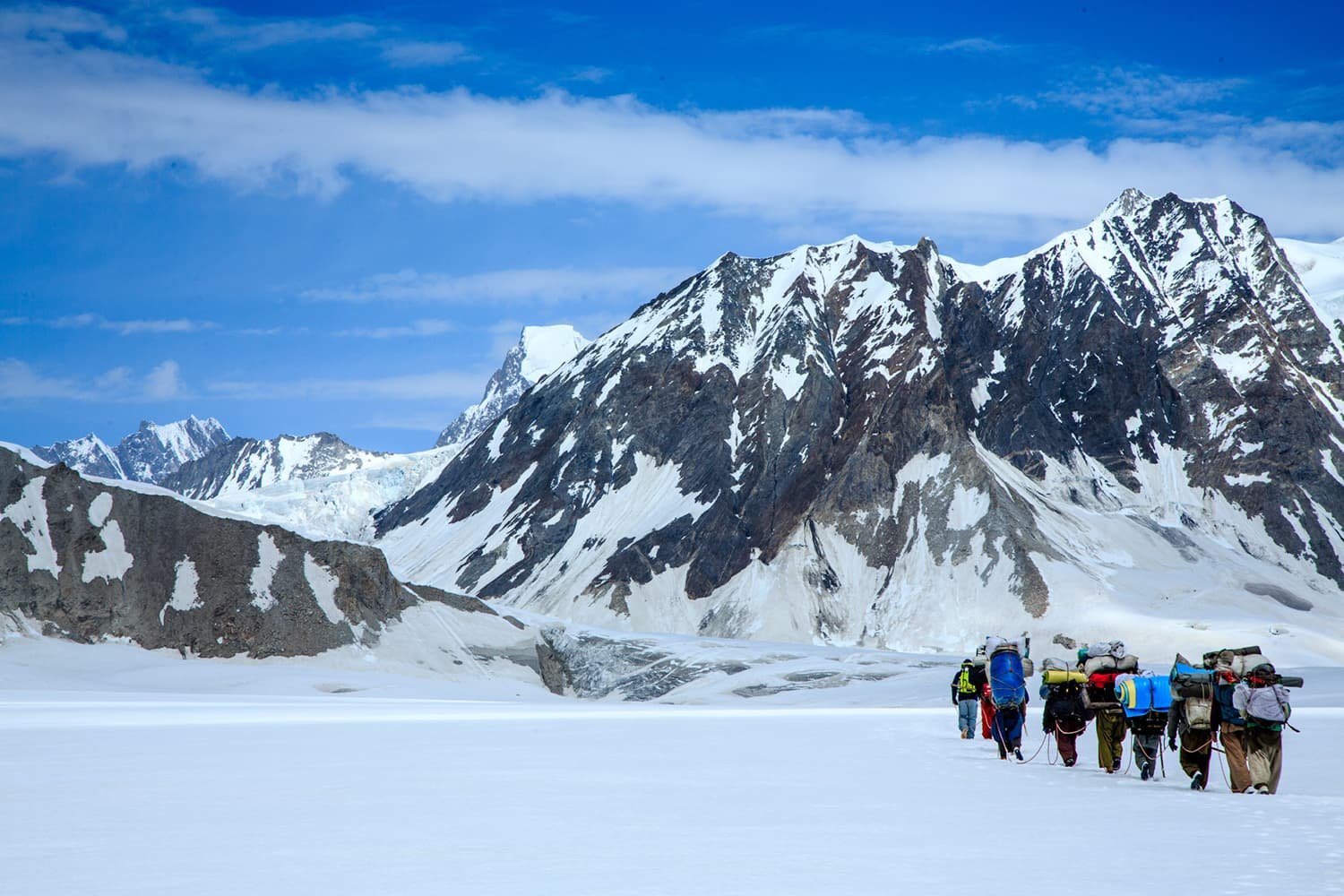
Martin Conway described the basin in 1892, and the English name Snow Lake has been used ever since. Locally it is Lukpe Lawo, a high snow field rather than a body of water. There is no shore, no reflection in summer meltwater of the kind you find at lower lakes, and no settlement beside it. What you see is a wide, almost level expanse of névé — compacted snow feeding the glaciers — ringed by granite peaks.
That is also why photographs can confuse first-time visitors. The whiteness looks like a frozen lake from a distance, especially from Hispar La. Underfoot, it is glacier travel: hidden crevasses, bright snow, and the need to rope up, particularly later in the morning when the surface softens.
Height, size and the two glaciers
Snow Lake sits at about 4,800 to 4,900 metres; a commonly cited figure is 4,877 metres (16,000 feet). The basin is roughly 16 kilometres across. The Biafo Glacier is about 67 kilometres long, and the Hispar Glacier about 49 kilometres. Together they form one of the longest continuous glacier systems outside the polar regions, which is the real significance of the place.
Around the basin rise some of the most impressive granite walls in the Karakoram, including the Ogre (Baintha Brakk) and the Latok group. The trek is not a climbing expedition, but the architecture of those peaks is a large part of why the crossing stays in the memory.
How the Biafo–Hispar traverse works
A typical Snow Lake Pakistan itinerary lasts well over two weeks, including travel between Islamabad, Skardu and the roadheads. After Askole, the first days follow the Biafo moraine through camps such as Namla, Mango and Baintha. Baintha, a green meadow at about 4,000 metres, is usually used as an acclimatization stop before the route moves onto continuous snow.
Beyond Baintha, trekkers step onto the white upper glacier and move toward the Sim Gang junction and then into the Snow Lake basin itself. A high camp is often placed below Hispar La. The pass, at about 5,150 metres, is the high point of the trek and the moment when the view back across the basin is at its widest. The descent follows the Hispar Glacier, which is more broken and laborious than the Biafo, down to Hispar village and then by jeep to Karimabad in the Hunza Valley.
Skardu Expedition runs this traverse as a fully supported trek, with a licensed guide, porters, camping equipment and the permits required for a restricted route through Central Karakoram National Park.
How hard is the trek?
The crossing is strenuous, and on the upper snow it is more isolated than the standard walk to K2 Base Camp. You do not need to be a technical climber, but you do need to be comfortable walking for many hours on uneven glacier, using crampons and an ice axe, and travelling on a rope where the snow is crevassed. The Hispar side, with its side glaciers and moraine, is often the more tiring half.
Compared with a K2 Base Camp trek, the Snow Lake trek spends more time on open ice and less time on a well-used moraine highway. The reward is the scale of the basin and the feeling of crossing from Baltistan into Hunza on a river of ice. The cost of that reward is self-sufficiency: everything you need must be carried in, and there is no simple retreat once you are high on the glacier.
Permits and practical planning
Foreign trekkers need a trekking visa or the correct restricted-area paperwork, an official permit, and a licensed guide through a registered operator. The usual season is late June to mid-August, when the glaciers are in their most workable summer condition. Weather still decides everything: fresh snow can hide crevasses, and storms can pin a team in camp. A well-built itinerary includes rest and buffer days rather than a tight dash for the pass.
Frequently asked questions
Where exactly is Snow Lake in Pakistan?
Snow Lake, or Lukpe Lawo, is in the Karakoram of Gilgit-Baltistan, at the meeting of the Biafo and Hispar glaciers, between Askole in Baltistan and Hispar in Nagar, on the way to the Hunza Valley.
How high is Snow Lake?
The basin lies at about 4,800 to 4,900 metres, often given as 4,877 metres. The high point of the standard trek is Hispar La, a pass of about 5,150 metres.
How long does the trek take?
Plan for a full expedition-style itinerary of roughly two and a half weeks, including travel to and from Islamabad and Skardu, not just the days on the ice.
Is it harder than the K2 Base Camp trek?
It is generally more isolated and involves more travel on snow and crevassed glacier. The K2 Base Camp walk is a serious trek in its own right, but Snow Lake asks for greater comfort with roped glacier travel and a longer stretch high on the ice.