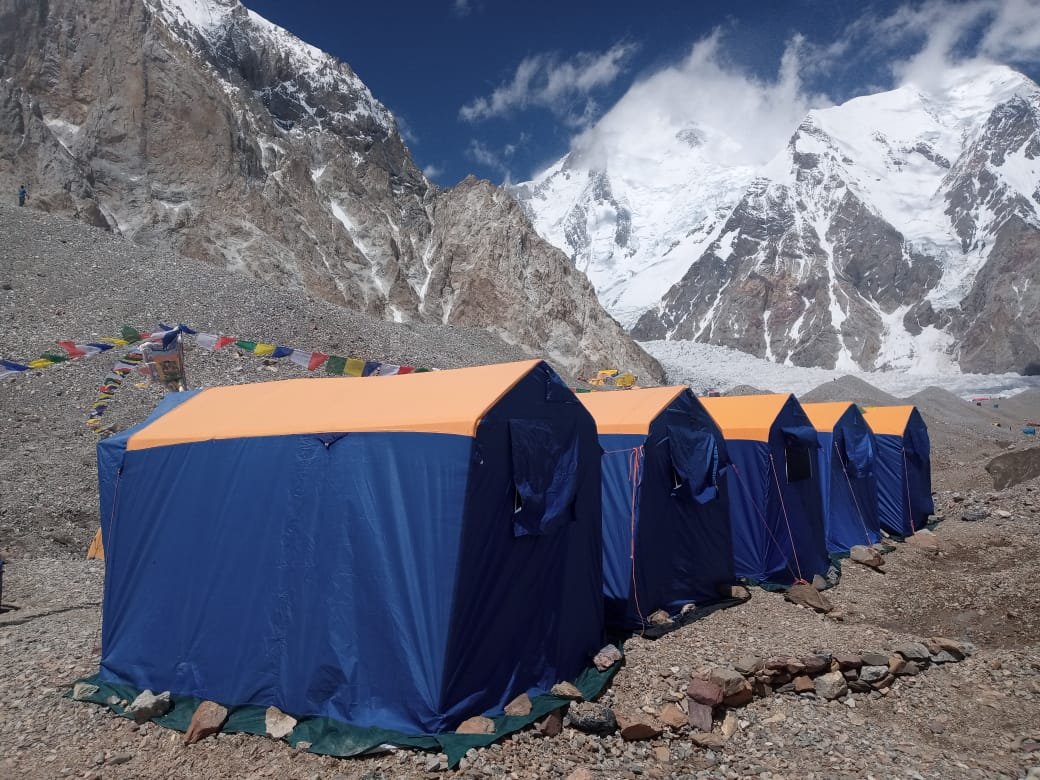
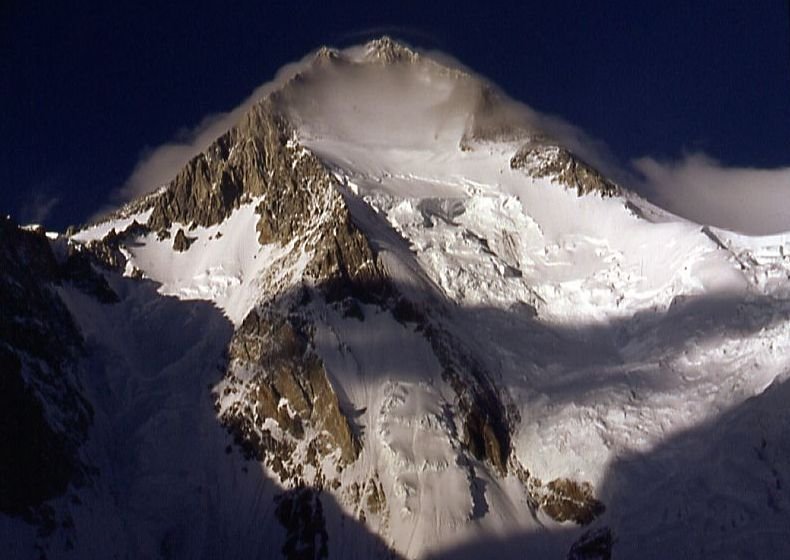
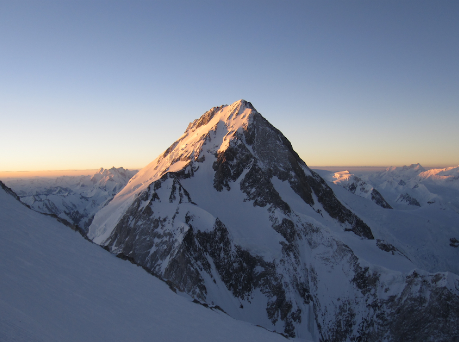
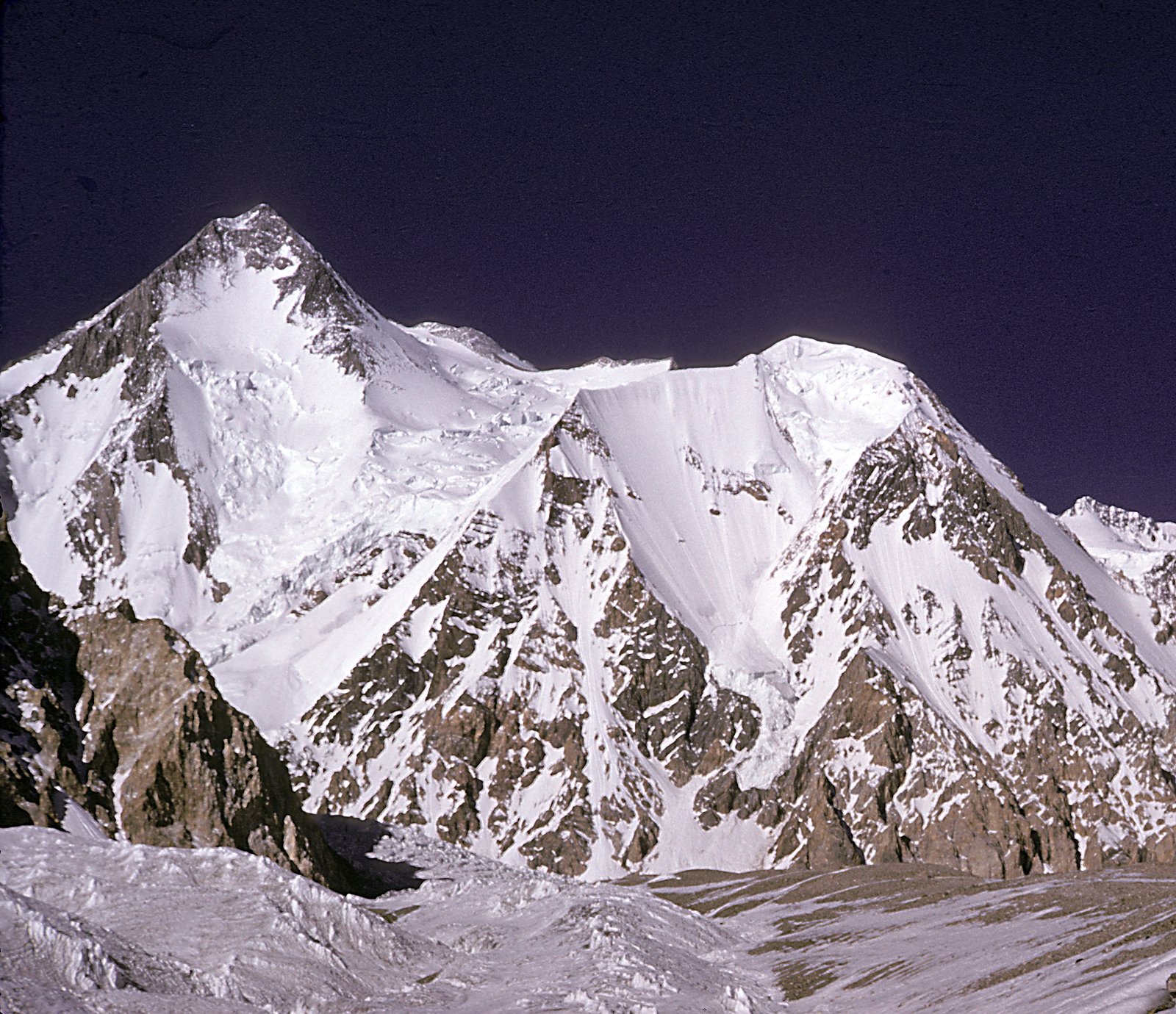
Gasherbrum I (8,080 m / 26,509 ft), also known as Hidden Peak or K5, is the eleventh-highest mountain on Earth and the fifth-highest peak in Pakistan. It stands in the Gasherbrum massif at the head of the South Gasherbrum Glacier in the central Karakoram range, straddling the border of Pakistan’s Gilgit-Baltistan region and China’s Xinjiang province. The name Gasherbrum derives from the Balti words rgasha (beautiful) and brum (mountain), meaning Beautiful Mountain — a fitting description of its elegant and imposing pyramid when viewed from Concordia. The designation Hidden Peak was given by the 1892 Conway Expedition because the summit is not visible from the Baltoro Glacier lower reaches, remaining concealed behind the surrounding ridges until climbers reach the upper glacier.
The mountain is the highest of the six Gasherbrum peaks and shares a Base Camp on the South Gasherbrum Glacier with its neighbour Gasherbrum II (8,035 m), making it a natural partner for a double 8,000 m expedition. The standard ascent route — the Northwest Face (American Route) — was first climbed in 1958 and involves a multi-stage climb through steep glaciated terrain, sustained upper-face couloirs reaching 55–60°, and a critical mixed rock-and-ice crux band at approximately 7,500–7,700 m that demands genuine technical climbing proficiency. Above the crux, a broad summit snowfield leads to the highest point. This technical character places G-I a step above Broad Peak and Gasherbrum II in difficulty, and climbers should arrive with strong ice and mixed climbing skills.
The first ascent of Gasherbrum I was made on 5 July 1958 by Americans Andrew Kauffman and Pete Schoening — the first American team to summit an 8,000 m peak. The climb was a landmark achievement, completed without the use of supplemental oxygen and with a lean, self-sufficient team typical of the best American alpinism of the era. Schoening had already made mountaineering history five years earlier during the 1953 K2 expedition with his legendary belay that arrested the fall of six climbers on the Abruzzi Spur. Today, Gasherbrum I receives fewer visiting teams than K2 or the more famous 8,000 m peaks, preserving a sense of remoteness and adventure that many climbers prize above all.
Equipment & Gear List
The following lists represent the minimum recommended equipment for a Gasherbrum I expedition via the Northwest Face. Note the inclusion of a small rock protection rack for the mixed crux band above 7,500 m — this distinguishes G-I’s gear requirements from Broad Peak and Gasherbrum II. Personal pack weights at Base Camp should not exceed 22 kg.
1. Clothing & Footwear
| Item | Qty | Notes |
| Down Suit (7,500 m+ rated) | 1 | Essential for summit day and C3; 800 fill power minimum |
| Hard Shell Jacket & Pants | 2 sets | Waterproof/windproof Gore-Tex outer layer for all conditions |
| Softshell Jacket & Pants | 1 set | Mid-elevation climbing and camp use |
| Mid-Layer Fleece / Down Jacket | 2 | Insulation layer for Base Camp and lower camps |
| Base Layers (thermal top & bottom) | 3 sets | Moisture-wicking merino wool or synthetic; change regularly |
| Gloves: Liner / Mid / Expedition Mitts | 1 pair each | Three-layer glove system critical on summit day |
| Balaclava & Neck Gaiter | 2 each | Wind and cold protection above 7,000 m |
| Warm Hat & Sun Hat | 1 each | Wool beanie for cold; wide-brim for Baltoro glacier approach |
| High-Altitude Boots (7,500 m+ rated) | 1 pair | Double boots e.g. La Sportiva G2 Evo or Millet Everest |
| Trekking / Approach Boots | 1 pair | For Baltoro glacier approach to Base Camp |
| Camp Booties (insulated) | 1 pair | For inside tents at high camps |
| Gaiters | 1 pair | Snow exclusion on upper face couloirs; essential |
| Trekking Socks (wool/synthetic) | 6 pairs | Thick for high altitude; thinner for approach trek |
| Sunglasses (Category 4) | 2 pairs | Glacier UV is extreme; always carry a spare |
2. Climbing Hardware
| Item | Qty | Notes |
| Climbing Harness (expedition) | 1 | Must fit comfortably over bulky down suit |
| Ascender / Jumar (pair) | 1 pair | Fixed-rope ascent on steep couloirs above C1 |
| Belay / Rappel Device | 1 | ATC or Figure-8 for rappel descents |
| Locking Carabiners | 8–10 | Mix of screw-gate and auto-locking |
| Non-locking Carabiners | 10–12 | Clipping fixed lines and running protection |
| Ice Axe (technical curved pick) | 1–2 | One technical axe; one straight for glacier approach |
| Crampons (12-point technical) | 1 pair | Anti-balling plates; compatible with 7,500 m boots |
| Helmet (CE/UIAA certified) | 1 | Rockfall risk high on G-I’s couloirs and rocky bands |
| Trekking Poles (telescoping) | 1 pair | Glacier approach and high-camp descent support |
| Slings (120 cm & 60 cm) | 4–6 each | Dyneema for light weight; nylon for abrasion resistance |
| Prussik Cords (6 mm, 60 cm) | 2 | Self-rescue and crevasse extrication |
| Snow Pickets / Deadman Anchors | 4–6 | Team shared; upper face anchor building |
| Rock Protection (nuts, hexes) | Small rack | For the crux mixed band above 7,500 m on standard route |
3. Camp & Bivouac Equipment
| Item | Qty/Spec | Notes |
| 4-Season Expedition Tent | 2-person | Wind-rated 80+ km/h; freestanding semi-geodesic preferred |
| Sleeping Bag (-35°C rated) | 1 | For C3 and summit bid; 850+ fill power |
| Sleeping Bag (-15°C rated) | 1 | Base Camp and lower camps |
| Insulated Sleeping Pad (R-value 6+) | 2 | Foam + inflatable for redundancy on ice platforms |
| Expedition Backpack (75–85 L) | 1 | Load carrying between camps |
| Summit Pack (25–30 L) | 1 | Ultralight summit day pack; target under 8 kg loaded |
| Expedition Duffel Bags | 2–3 | For porter loads; max 25 kg per bag |
| High-Altitude Stove (MSR Reactor / Jet Boil) | 2 | Spare burner essential; test in sub-zero before trip |
| Fuel Canisters | 25–30 | ~3 canisters per camp per rotation at altitude |
| Insulated Cooking Pot & Mug | 1 set | Titanium or hard-anodised aluminium; insulated mug critical |
| Headlamp + Spare Batteries (lithium) | 2 headlamps | Pre-dawn summit start; lithium batteries only above 6,000 m |
| Water Bottles (insulated, 1 L wide-mouth) | 2 | Prevent freezing; Nalgene wide-mouth preferred |
| Water Purification Tablets / Filter | 1 | Lower camps and approach; boil at high altitude |
| High-Calorie Expedition Food | Full supply | Freeze-dried meals, nuts, gels, bars for all camps; ~4,000 kcal/day above 6,000 m |
3.4 Oxygen & Medical Equipment
| Item | Qty | Notes |
| Supplemental Oxygen Cylinders (4L) | 2–4 per climber | Recommended above 7,500 m; mandatory for emergencies |
| Oxygen Regulator + Mask | 1 set + spare | Altitude-rated regulator; flow rate 2–4 L/min on summit day |
| Gamow Bag (team, BC) | 1 | Portable hyperbaric chamber for HACE/HAPE treatment |
| Pulse Oximeter | 3 (team) | Monitor SpO2 at every camp; key safety tool |
| Dexamethasone 8 mg injectable | Per protocol | HACE emergency treatment; administer and descend |
| Nifedipine 30 mg extended-release | Per protocol | HAPE emergency treatment |
| Diamox (Acetazolamide) 250 mg | Per protocol | Acclimatization support; prophylactic and therapeutic use |
| SAT Phone + GPS/EPIRB Beacon | 1 each | Emergency communication and location signalling |
| Ibuprofen, Paracetamol, Co-codamol | Ample supply | Pain management and fever reduction |
| Oral Rehydration Salts + Loperamide | Ample supply | GI illness is common at altitude; critical for hydration |
Additional Medical Kit (per expedition)
Ibuprofen 400 mg, paracetamol, co-codamol — pain management and fever
Loperamide (Imodium) and oral rehydration salts — GI illness is common at altitude
Blister and wound kit: moleskin, compeed, wound closures, antiseptic wipes
Snowblindness drops: tetracaine for pain relief, antibiotic eye drops
Frostbite kit: ibuprofen 400 mg, aloe vera gel, non-adherent dressings, iloprost if available
Throat lozenges and steam inhaler — high-altitude dry cough is universal on G-I
Sunscreen SPF 50+ and lip balm SPF 30 — glacier UV exposure is severe
Affiliated with & Licence