LATEST
K2 Summer Expeditions 2026 — Now Accepting Bookings New Trek Added: Batura Glacier — Gilgit Zone Government Verified & Registered Agency · Skardu, GB 24/7 Customer Support · WhatsApp: +92 341 153 7783 Best Price Guarantee on All Packages Winter K2 Expedition Season · December – February K2 Summer Expeditions 2026 — Now Accepting Bookings New Trek Added: Batura Glacier — Gilgit Zone Government Verified & Registered Agency · Skardu, GB 24/7 Customer Support · WhatsApp: +92 341 153 7783 Best Price Guarantee on All Packages Winter K2 Expedition Season · December – February

Gasherbrum II Expedition

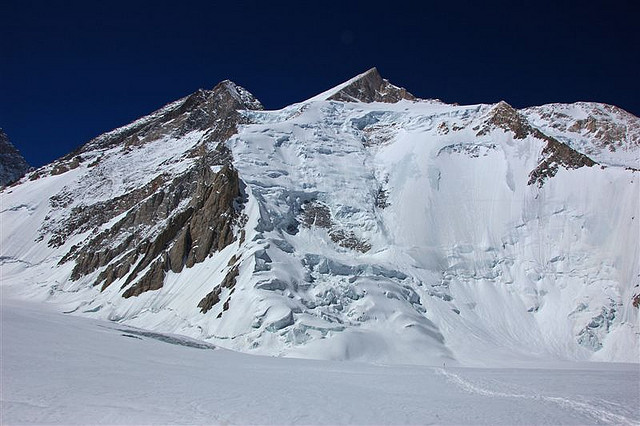
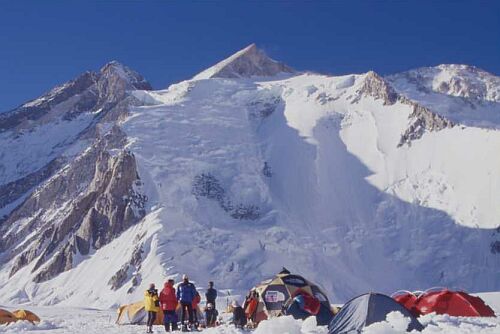
Gasherbrum II (8,035 m / 26,362 ft), also known by its survey designation K4, is the thirteenth-highest mountain on Earth and the fourth-highest peak in Pakistan. Situated in the Gasherbrum massif at the head of the South Gasherbrum Glacier in the central Karakoram range, it straddles the border between Pakistan’s Gilgit-Baltistan region and China’s Xinjiang province. Like its near-neighbour Gasherbrum I, the name derives from the Balti language — rgasha brum — meaning Beautiful Mountain, a testament to the elegance and symmetry that defines the entire Gasherbrum group. The mountain’s most prominent feature as seen from Concordia is its graceful, sweeping Southeast Ridge, which forms the backbone of the standard climbing route and gives the peak its characteristic pyramid silhouette against the Karakoram sky.

Gasherbrum II holds a special place among the world’s 8,000 m peaks as one of the most suitable objectives for an alpinist’s first venture above 8,000 metres. Its standard route — the Southeast Ridge — involves long, sustained high-altitude climbing on moderate to steep snow and ice (averaging 40–50°) without the extreme mixed rock sections, major seracs, or complex route-finding challenges found on technically harder 8,000 m peaks. The summit success rate of approximately 40–45% is among the highest of any 8,000 m peak, reflecting both the route’s relative directness and the quality of weather windows typically available in July. However, these statistics should not encourage complacency: every metre above Base Camp on G-II is in the thin air of high altitude, the summit day spends hours in the death zone above 8,000 m, and the consequences of a weather reversal or altitude illness at Camp 3 are severe.

The first ascent of Gasherbrum II was made on 7 July 1956 by an Austrian team: Fritz Moravec, Josef Larch, and Hans Willenpart, guided by the expedition leader — a significant achievement in the golden decade of Himalayan first ascents. The peak was climbed without supplemental oxygen, following the Southeast Ridge that remains the standard route to this day. A landmark in the mountain’s more recent history was the first winter ascent on 2 February 2011 by Simone Moro, Denis Urubko, and Cory Richards — the first winter summit of an 8,000 m peak by a team that did not include any Nepali climbers, and a journey memorably documented in the film Cold. Today, Gasherbrum II attracts a diverse range of teams and is frequently used as an acclimatization peak before a subsequent G-I or K2 attempt.

Equipment & Gear List

The following lists represent the minimum recommended equipment for a Gasherbrum II expedition via the Southeast Ridge. G-II’s predominantly snow and ice terrain requires a slightly leaner hardware rack than G-I, with no rock protection needed on the standard route. Personal pack weights at Base Camp should not exceed 22 kg.

1. Clothing & Footwear

Item Qty Notes
Down Suit (7,000 m+ rated) 1 For summit day and Camp 3; 750–800 fill power minimum
Hard Shell Jacket & Pants 2 sets Waterproof/windproof Gore-Tex outer layer; essential for storm days
Softshell Jacket & Pants 1 set Mid-elevation climbing, camp use, and approach
Mid-Layer Fleece / Down Jacket 2 Insulation layer for Base Camp and lower camps
Base Layers (thermal top & bottom) 3 sets Moisture-wicking merino wool or synthetic; change after each rotation
Gloves: Liner / Mid / Expedition Mitts 1 pair each Three-layer glove system; spare liners recommended
Balaclava & Neck Gaiter 2 each Wind and cold protection on summit ridge and upper snowfields
Warm Hat & Wide-Brim Sun Hat 1 each Beanie for cold camps; wide-brim for Baltoro glacier approach
High-Altitude Boots (7,000 m+ rated) 1 pair Double boots e.g. La Sportiva Olympus Mons or Millet Everest
Trekking / Approach Boots 1 pair For Baltoro glacier approach trek
Camp Booties (insulated) 1 pair Inside tent use at high camps
Gaiters 1 pair Essential on upper snowfields and glacier approach
Trekking Socks (wool/synthetic) 6 pairs Thick for high altitude; thinner for approach trek
Sunglasses (Category 4) 2 pairs Glacier UV is severe; always carry a spare pair


2. Climbing Hardware

Item Qty Notes
Climbing Harness (expedition) 1 Must fit comfortably over down suit; test fit before departure
Ascender / Jumar (pair) 1 pair Fixed-rope progress on steeper sections of Southeast Ridge
Belay / Rappel Device (ATC or Figure-8) 1 For rappel descents on Southeast Ridge
Locking Carabiners 8–10 Mix of screw-gate and auto-locking styles
Non-locking Carabiners 8–10 Clipping fixed lines and running protection
Ice Axe (technical curved pick) 1–2 One technical axe for steep sections; one straight for approach
Crampons (12-point technical) 1 pair Anti-balling plates; compatible with 7,000 m boots
Helmet (CE/UIAA certified) 1 Serac and ice debris hazard above C2
Trekking Poles (telescoping) 1 pair Glacier approach support and descent stability
Slings (120 cm & 60 cm) 4–6 each For anchor building and clipping fixed protection
Prussik Cords (6 mm, 60 cm) 2 Self-rescue, crevasse extrication
Snow Pickets / Snow Stakes 4–6 Team shared; upper snowfield anchor construction


3. Camp & Bivouac Equipment

Item Qty/Spec Notes
4-Season Expedition Tent 2-person Wind-rated 80+ km/h; semi-geodesic freestanding preferred
Sleeping Bag (-30°C rated) 1 For C3 and summit night; 800+ fill power down
Sleeping Bag (-15°C rated) 1 Base Camp and Camps 1 and 2
Insulated Sleeping Pad (R-value 5+) 2 Foam + inflatable for redundancy on icy tent platforms
Expedition Backpack (70–80 L) 1 Load carrying between camps
Summit Pack (25–30 L) 1 Lightweight summit day pack; aim under 8 kg loaded
Expedition Duffel Bags 2–3 For porter loads; max 25 kg each
High-Altitude Stove (MSR Reactor / Jet Boil) 2 Spare burner critical; test in cold conditions before trip
Fuel Canisters 20–25 ~2–3 canisters per camp per rotation
Insulated Cooking Pot & Mug 1 set Titanium or hard-anodised; insulated mug essential at altitude
Headlamp + Spare Batteries (lithium) 2 headlamps Pre-dawn summit departure; lithium cells only above 6,000 m
Water Bottles (insulated, 1 L wide-mouth) 2 Wide-mouth Nalgene; prevents freezing above 7,000 m
Water Purification Tablets / Filter 1 For lower camps; boil water at high altitude
High-Calorie Expedition Food Full supply Freeze-dried meals, nuts, gels, energy bars; ~4,000 kcal/day above 6,000 m


4. Oxygen & Medical Equipment

Item Qty Notes
Supplemental Oxygen Cylinders (4L) 2–4 per climber Optional on G-II; strongly recommended above 7,500 m and for emergencies
Oxygen Regulator + Mask 1 set + spare Altitude-rated regulator; flow 2–4 L/min on summit day if used
Gamow Bag (team, BC) 1 Portable hyperbaric chamber; essential for HACE/HAPE emergencies
Pulse Oximeter 3 (team) Monitor SpO2 at every camp; key safety and acclimatization tool
Dexamethasone 8 mg injectable Per protocol HACE emergency treatment — administer and descend immediately
Nifedipine 30 mg extended-release Per protocol HAPE emergency treatment
Diamox (Acetazolamide) 250 mg Per protocol Acclimatization support; prophylactic and treatment use
SAT Phone + GPS / EPIRB Beacon 1 each Emergency communication and location signalling from any camp
Ibuprofen, Paracetamol, Co-codamol Ample supply Pain management, headache, and fever at altitude
Oral Rehydration Salts + Loperamide Ample supply Gastrointestinal illness is common; critical for hydration maintenance

Additional Medical Kit (per expedition)

  • Ibuprofen 400 mg, paracetamol, co-codamol — pain management, headache, and fever
  • Loperamide (Imodium) and oral rehydration salts — gastrointestinal illness is common
  • Blister and wound kit: moleskin, compeed pads, wound closure strips, antiseptic wipes
  • Snowblindness drops: tetracaine for pain relief; antibiotic eye drops for infection
  • Frostbite kit: ibuprofen 400 mg, aloe vera gel, non-adherent dressings
  • Throat lozenges and portable steam inhaler — high-altitude dry cough is universal
  • Sunscreen SPF 50+ and lip balm SPF 30 — glacier UV reflection causes rapid sunburn
  • Vitamin C, zinc, and iron supplements — immune and haematological support on long expeditions
Q1: What is Gasherbrum II and what makes it distinctive?
Gasherbrum II (8,035 m / 26,362 ft), also designated K4, is the thirteenth-highest mountain in the world and the fourth-highest in Pakistan. It sits in the Gasherbrum massif of the central Karakoram, sharing a Base Camp on the South Gasherbrum Glacier with Gasherbrum I. The mountain is renowned for its beautiful, symmetrical Southeast Ridge — the standard route — which offers a long, sustained high-altitude climb without extreme technical difficulty. G-II is widely regarded as one of the most accessible 8,000 m peaks for competent high-altitude alpinists, with a summit success rate of approximately 40–45%, among the highest of any 8,000 m peak. Despite this relative accessibility, it is a serious objective: the sustained altitude, objective hazards, and death zone exposure above 8,000 m demand full 8,000 m expedition preparation.
Q2: What is the standard route on Gasherbrum II?
The standard route is the Southeast Ridge, first climbed by an Austrian team in 1956. From Base Camp on the South Gasherbrum Glacier, the route follows the broad lower glacier to Camp 1 on a snow shelf, then ascends moderate to steep snow slopes through Camps 2 and 3 to the upper Southeast Ridge. Above Camp 3, the route gains the summit snowfield and follows the ridge to the highest point (8,035 m). The technical difficulties are limited compared to most other 8,000 m peaks — sustained snow and ice slopes averaging 40–50°, with no significant rock bands or mixed terrain on the standard line. This makes G-II one of the most suitable objectives for a climber's first 8,000 m summit.
Q3: When is the best season to attempt Gasherbrum II?
The viable climbing season is the summer window from late June to mid-August. July consistently offers the most stable weather patterns on the Gasherbrum massif, with the best chance of 3–5 day summit windows. Like all Karakoram peaks, G-II is subject to rapid weather deterioration driven by southwest monsoon cycles. Teams should allow at least 10–15 days of Base Camp time specifically for weather waiting. No successful winter ascent of G-II had been recorded until February 2011, when a Slovenian-Italian-Russian team — including Simone Moro and Denis Urubko — made the historic first winter ascent.
Q4: What permits are required and what is the cost?
A Royalty Permit from Pakistan's Ministry of Tourism and the Pakistan Alpine Club (PAC) is mandatory for all climbers. The current permit fee for Gasherbrum II is approximately USD 1,150 per climber. All expeditions must include a government-appointed Liaison Officer (LO), whose salary (~USD 1,500 for the expedition) and all expenses are the team's responsibility. An environmental deposit, refundable upon clean departure, and compulsory porter insurance are also required. Permit applications should be submitted at least 3 months before the planned start date. accident
Q5: Is it practical to combine G-II with Gasherbrum I in a single expedition?
Combining G-II with Gasherbrum I (8,080 m) in a single expedition is very common and logistically efficient, as both peaks share the same Base Camp on the South Gasherbrum Glacier and require the same Baltoro Glacier approach. The standard strategy is to summit G-II first — using it as an acclimatization peak — before attempting the more technically demanding G-I. A combined expedition requires separate permits for each peak and typically runs 65–75 days. The added cost per summit is partially offset by sharing the approach, porter, LO, and Base Camp logistical costs.
Q6: What level of experience is required for Gasherbrum II?
G-II is suitable for experienced alpinists making their first 8,000 m attempt, provided they have a solid foundation of high-altitude experience. Minimum recommended prerequisites include at least one summit at 6,500 m or higher, proficiency on steep snow and ice (crampon technique to 50°, competent self-arrest and ice axe use), fixed-rope ascending skills, and crevasse rescue training. Strong aerobic fitness is essential — the summit day from Camp 3 (7,000 m) to the top (8,035 m) involves over 1,000 m of gain entirely in the death zone, typically taking 8–12 hours round-trip. Guided operators generally require a minimum of two 6,000 m peaks as prerequisites.
Q7: Is supplemental oxygen used on Gasherbrum II?
G-II is among the 8,000 m peaks most frequently climbed without supplemental oxygen. Many guided and independent teams complete the ascent without it, and it is generally considered a suitable objective for an oxygen-free debut at 8,000 m for well-acclimatized climbers. However, oxygen is recommended for any climber without prior 7,500 m+ experience, and all teams must carry emergency oxygen regardless of summit strategy. The summit day spends several hours above 8,000 m in the death zone, where cognitive impairment, fatigue, and frostbite risk escalate rapidly with any delay or deterioration in conditions.
Q8: What are the main objective hazards on the Southeast Ridge route?
The primary objective hazards on G-II's Southeast Ridge include crevasse falls on the South Gasherbrum Glacier between Base Camp and Camp 1, serac and ice cliff exposure above Camp 2 on the upper glacier, and wind slab avalanche risk on the broad upper snowfields following fresh snowfall. The summit ridge above Camp 3 can be heavily corniced in certain seasons, requiring careful route-finding close to but not on the cornice edge. Altitude-related illness — AMS, HACE, and HAPE — is a risk at all stages above Base Camp and escalates significantly above 7,000 m.
Q9: How long does a Gasherbrum II expedition typically take?
A standard G-II-only expedition runs approximately 48–55 days from Islamabad arrival to return. This includes the 6-day approach trek from Askole to Base Camp, 4–6 weeks on the mountain for acclimatization rotations and summit bids, and the 5-day trek out. Teams should treat the 35-day schedule outlined in this document as optimistic — weather delays of 10–14 days at Base Camp are routine. Climbers combining G-II with G-I should budget 65–75 days. Building flexibility into the return travel schedule is strongly advised.
Q10: What is the typical cost of a Gasherbrum II expedition?
A fully supported guided expedition to G-II costs between USD 12,000 and USD 28,000 per climber, depending on the operator, services included, and whether supplemental oxygen is provided. This typically covers permits (~USD 1,150), LO fees, porter wages on the approach and trek-out, Base Camp cook and kitchen staff, shared tents, fixed ropes, and guide fees. Independent expeditions can be arranged for USD 7,000–13,000 but require full self-sufficiency in logistics, route-finding, and emergency management. Climbers combining G-II with G-I save significantly on shared logistics costs.
Q11: How are altitude illnesses managed on expedition
Every expedition team should include or contract a qualified expedition doctor stationed at Base Camp throughout the climb. Daily SpO2 monitoring at all camps is essential — readings below 60% at rest warrant immediate attention. AMS is managed with rest, hydration, and Diamox; any worsening requires descent. HACE (confusion, ataxia) and HAPE (breathlessness at rest, persistent cough, pink frothy sputum) are life-threatening emergencies requiring immediate descent, supplemental oxygen, and administration of dexamethasone (HACE) or nifedipine (HAPE). The Base Camp Gamow bag provides emergency hyperbaric treatment. Helicopter evacuation is possible to Base Camp (~5,100 m) in good weather but cannot be relied upon as the primary rescue plan.
Day 1–2: Islamabad Arrival
Arrive in Islamabad. Team briefing, permit collection from Pakistan Alpine Club (PAC), gear inspection and consolidation. Hotel rest and final equipment purchases.
Day 3: Islamabad → Skardu
Fly to Skardu (2,438 m) or drive via Karakoram Highway (~20 hours). Short acclimatization walk around Kachura Lake (~2,500 m). Rest and porter coordination.
Day 4–5: Skardu Preparation
Final resupply, porter hiring and load packing. Medical briefing and altitude medication orientation by expedition doctor. Acclimatization hike to Sadpara Lake (~3,200 m).
Day 6: Skardu → Askole
4–5 hour jeep drive along the Braldu River Valley to Askole (3,015 m), the last inhabited village before the glacier. Camp setup and porter loads finalized (max 25 kg per load).
Day 7–8: Askole → Jhola & Paju
Day 7: Trek to Jhola (3,110 m) through dramatic river gorge terrain. Day 8: Advance to Paju (3,400 m) with first sightings of Trango Tower and Uli Biaho. Cook camp established.
Day 9: Paju Rest Day
Mandatory acclimatization rest at Paju, required by PAC regulations. Short moraine hike for acclimatization. Final crampon and harness fitting checks. Glacier briefing for porters.
Day 10–11: Paju → Urdukas & Goro II
Trek across the Baltoro Glacier. Day 10: Camp at Urdukas (4,050 m) — sweeping views of Cathedral Spires and Lobsang Spire. Day 11: Advance to Goro II (4,300 m).
Day 12: Goro II → Concordia
Arrive at Concordia (4,600 m) — the grand amphitheatre of the Karakoram. First clear views of Gasherbrum II's elegant Southeast Ridge and the entire Gasherbrum massif.
Day 13: Concordia → G-II Base Camp
Trek ~3 hours southeast up the South Gasherbrum Glacier to the shared Gasherbrum Base Camp (5,100 m). Establish Base Camp, set up all tents, cook tent, and medical station
Day 14–18: Base Camp Acclimatization
Rest and hydration at Base Camp. Doctor conducts baseline SpO2 and full health assessments. Glacier walks for acclimatization. Loads prepared for Camp 1 carries.
Day 19–22: Camp 1 Rotation (5,850 m) First rotation up the lower Southeast Ridge glacier to Camp 1 on the broad snow shelf. Fix ropes on steeper initial sections. Sleep one night at C1. Return to BC for 2-day rest.
First rotation up the lower Southeast Ridge glacier to Camp 1 on the broad snow shelf. Fix ropes on steeper initial sections. Sleep one night at C1. Return to BC for 2-day rest.
Day 23–26: Camp 2 Rotation (6,400 m)
Second rotation. Ascend through the broad upper glacier and moderate snow slopes to Camp 2. Stock C2 with food, fuel, and hardware. Return to BC for full 2-day rest.
Day 27–30: Camp 3 Rotation (7,000 m)
Third rotation up the Southeast Ridge to Camp 3, below the final summit snowfields. Fix remaining ropes above C3 if needed. Oxygen systems checked if carried. Return to BC for 2–3 day rest.
Day 31–35: Weather Window Monitoring
Active weather monitoring at Base Camp via MeteoBlue satellite forecasts. Short glacier fitness walks. Doctor conducts final health assessments. Summit bid logistics finalized
Day 36: BC → Camp 1 (Summit Bid Day 1)
Depart Base Camp. Ascend to Camp 1 (5,850 m) on the Southeast Ridge. Rest, high-calorie meals, and full equipment checks. Weather forecast reviewed over radio with BC.
Day 37: Camp 1 → Camp 2 (Summit Bid Day 2)
Ascend to Camp 2 (6,400 m). Maintain steady, energy-conserving pace. Hydrate with warm liquids throughout. Limit time outside tent. Weather confirmed for C3 push next day.
Day 38: Camp 2 → Camp 3 (Summit Bid Day 3)
Ascend to Camp 3 (7,000 m). Summit pack reduced to under 8 kg. Oxygen systems pressure-checked if used. Final weather forecast confirmed over radio. Sleep by 6:00 PM.
Day 39: Summit Day (8,035 m)
Depart C3 at 1:00–2:00 AM. Ascend the upper Southeast Ridge and final summit snowfield to the highest point (8,035 m). Return to C3 the same day. Critical: reach the summit by noon and descend before dark
Day 40–41: Descent to Base Camp
Day 40: Descend from C3 through C2 and C1 to Base Camp. Full medical checks and rehydration. Celebration dinner. Day 41: Full rest day at Base Camp.
Day 42–46: Base Camp → Askole Trek Out
Reverse the approach: Concordia → Goro II → Urdukas → Paju → Jhola → Askole over 4–5 days. Porter wages settled at Askole village.
Day 47–48: Askole → Skardu → Islamabad
Drive from Askole to Skardu. Team debrief dinner. Fly or drive to Islamabad. Permits and Liaison Officer paperwork returned to PAC. Expedition concludes.

Fill up the Form

Inquiry Form

Affiliated with & Licence

Affiliated 1
Affiliated 2
Affiliated 3
Chat with us on WhatsApp
Scroll to Top