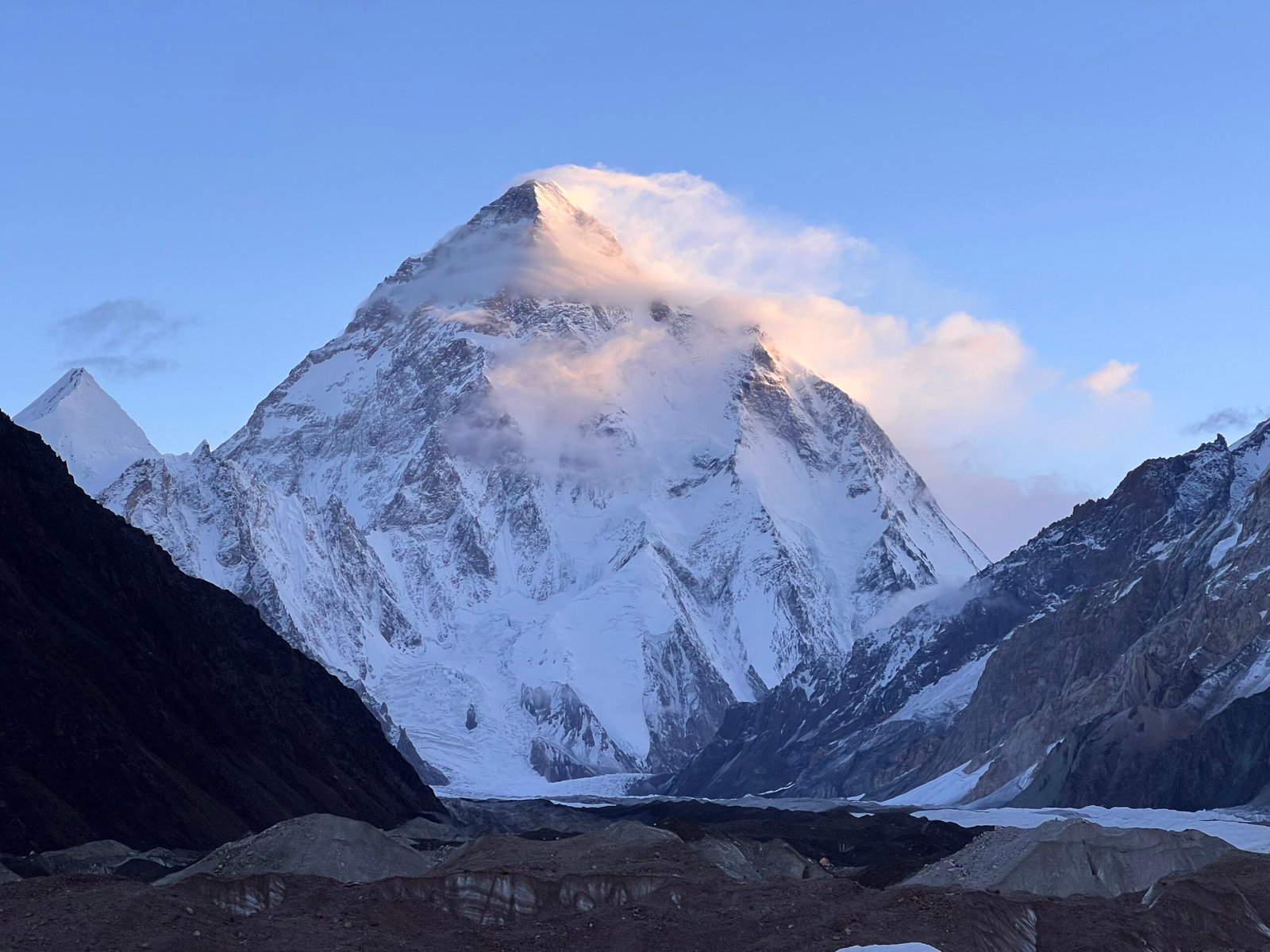
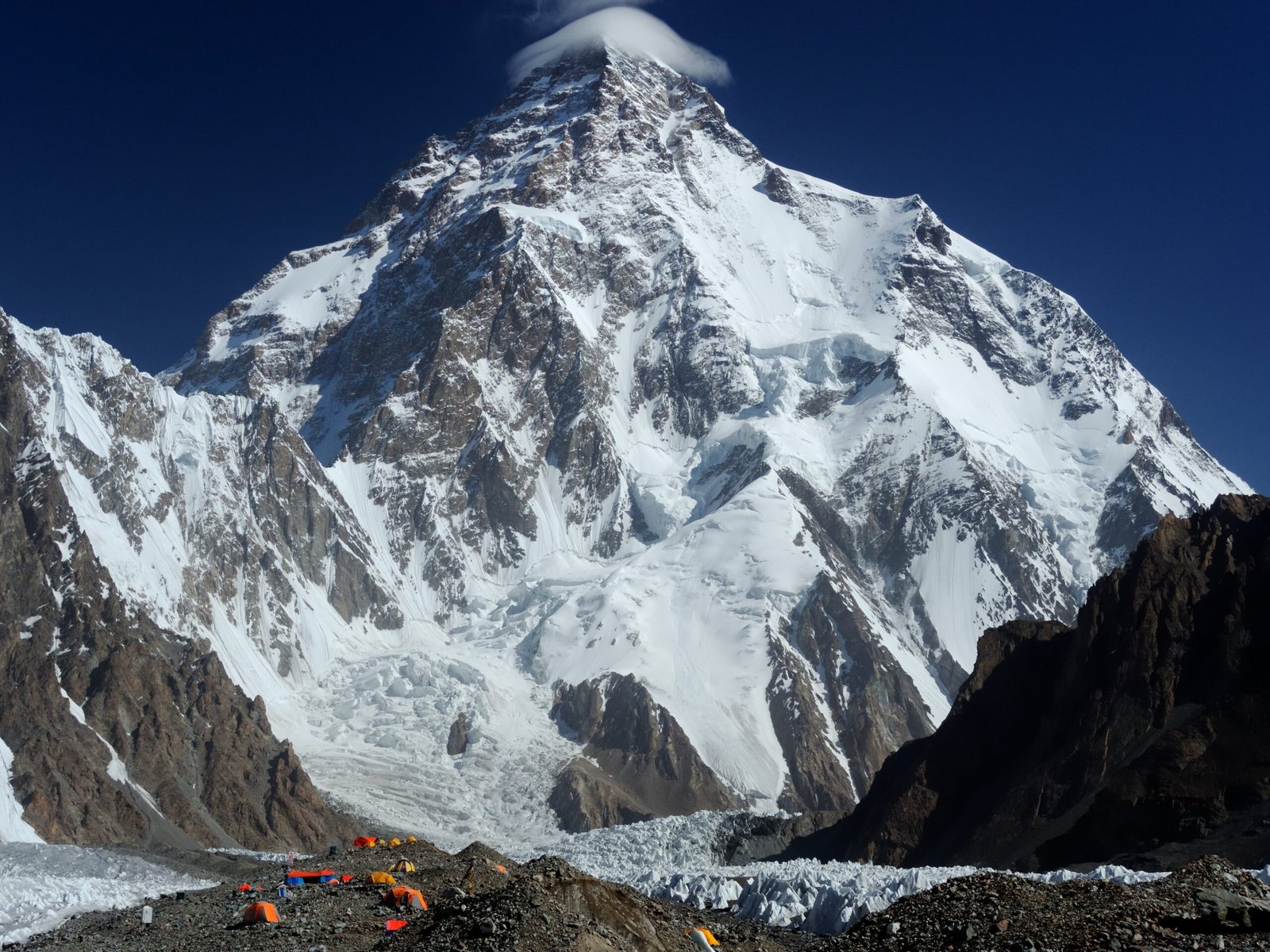
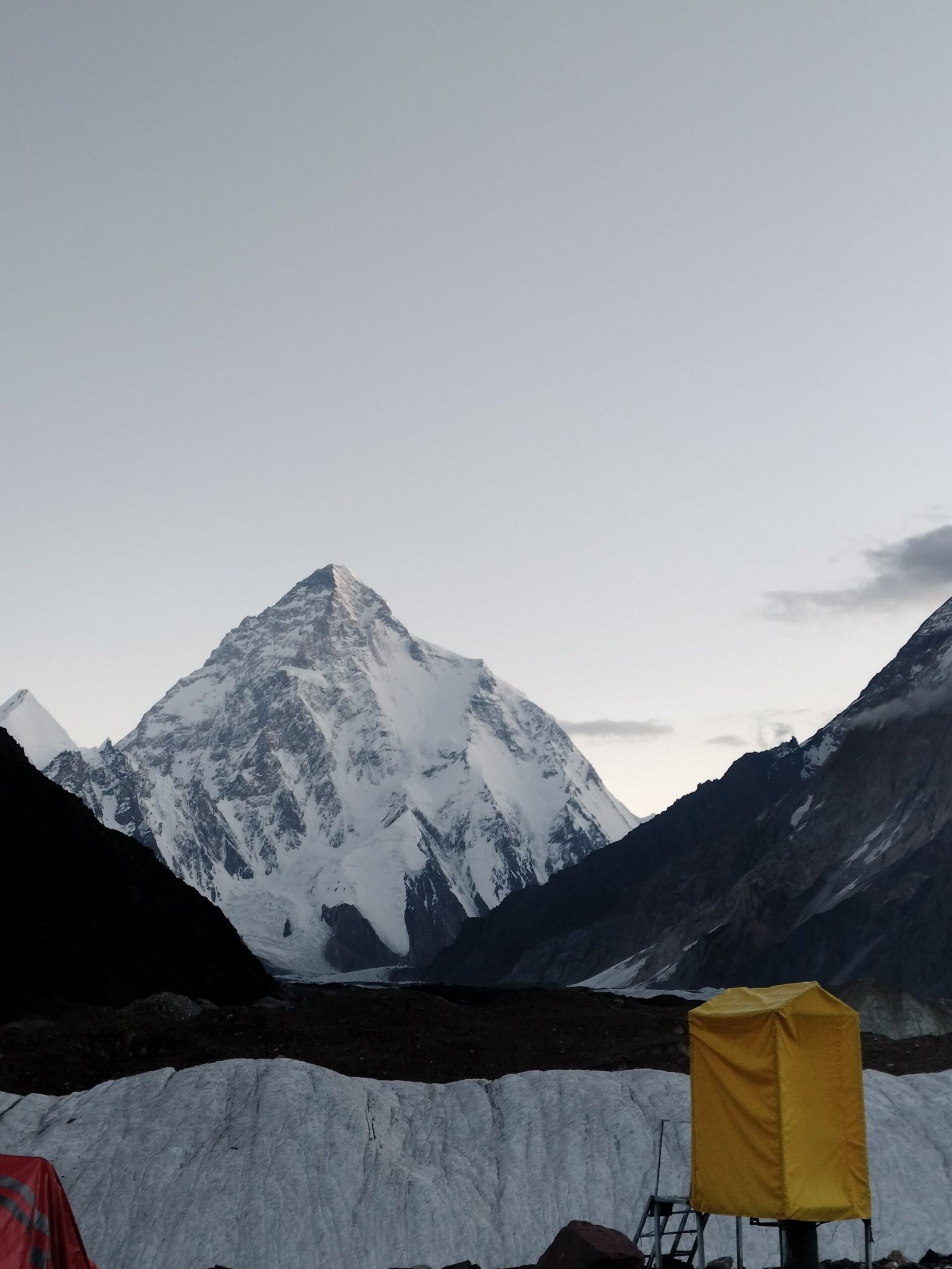
Broad Peak (8,047 m / 26,401 ft) is the twelfth-highest mountain in the world and the third-highest peak in Pakistan, located on the border of Pakistan’s Gilgit-Baltistan region and China’s Xinjiang province in the central Karakoram range. It sits just 8 kilometres northeast of K2, and the two peaks share a Base Camp area on the Godwin-Austen Glacier. The mountain takes its name from the remarkably wide summit plateau — nearly 1.5 kilometres across — that was clearly visible to early surveyors from Concordia. Its official survey designation is K3, assigned during the same Great Trigonometrical Survey that named K2.
Broad Peak is often described as one of the more accessible 8,000-metre peaks, earning it the somewhat misleading nickname the Gentle Giant. While it lacks the extreme technical difficulty of K2 or the extreme altitude of Everest, it is by no means a straightforward objective. The standard route — the West Face and Northwest Ridge — involves a long glacier approach, steep snow couloirs, and a summit day that crosses the infamous Fore Summit (8,028 m) before continuing along a corniced ridge to the true Main Summit. The vertical gain from Base Camp to the summit exceeds 3,100 metres, and the summit push from the highest camp typically takes 10–14 hours round-trip. Poor weather, avalanche risk on the upper couloirs, and the insidious challenge of spending hours in the death zone above 8,000 m make Broad Peak a serious undertaking.
The first ascent was made on 9 June 1957 by an Austrian team: Fritz Wintersteller, Marcus Schmuck, Kurt Diemberger, and Hermann Buhl — the legendary first ascentionist of Nanga Parbat. Remarkably, all four reached the summit without the use of high-altitude porters or supplemental oxygen, an extraordinary achievement for the era. Buhl died just 10 days later attempting Chogolisa nearby, adding a sombre chapter to Broad Peak’s history. Today, the mountain attracts climbers from around the world seeking their first 8,000 m summit or using it as acclimatization for a subsequent K2 attempt.
K2 demands 8,000m-grade technical equipment in addition to standard trekking kit. The checklist below covers the personal gear each climber must bring; group climbing hardware (fixed rope, snow bars, ice screws for camp anchoring) is provided as part of the expedition package. A full kit inspection is carried out in Skardu on Day 2.
| 1 | Head & Eyes
8,000m down-insulated summit hood/balaclava; glacier goggles (cat. 4) plus UV-rated sunglasses; climbing helmet (UIAA-certified); headlamp with spare batteries. |
| 2 | Upper Body
8,000m one-piece down summit suit; down/synthetic belay jacket; softshell climbing jacket; fleece mid-layer; merino wool base layers (2–3 sets). |
| 3 | Lower Body
8,000m summit suit bibs (if not one-piece); softshell climbing pants; merino wool thermal bottoms; waterproof/windproof shell pants for the approach trek. |
| 4 | Hands
8,000m down summit mitts; insulated climbing gloves (mid-weight); thin liner gloves for technical sections and camp chores. |
| 5 | Feet
Triple-layer 8,000m climbing boots (e.g. La Sportiva Olympus Mons, Millet Everest, or equivalent) with integrated supergaiter; down camp booties for Base Camp and high camps; liner socks plus heavyweight climbing socks (3–4 pairs). |
| 6 | Technical Hardware
Mountaineering harness (rated for cold/altitude); ice axe (general mountaineering) plus a technical/steep-ice axe for the Bottleneck; 12-point crampons compatible with summit boots; ascender/jumar; figure-8 or mechanical descender; 4–6 locking and 4–6 non-locking carabiners; 2 x 120cm and 1 x 60cm nylon slings; 2 prusik cords; personal 30–40m dynamic rope section (route-dependent, confirm with expedition leader). |
| 7 | Sleeping & Shelter
Expedition-grade down sleeping bag rated to at least −40°C for high camps; inflatable 4-season sleeping mat plus closed-cell foam pad; Base Camp duffel bags (2, for porter/yak transport). |
| 8 | Oxygen (optional add-on)
Summit oxygen mask and regulator, 4–6 cylinders per climber, and a pulse oximeter — arranged through the expedition (see package add-ons) rather than carried independently. |
| 9 | Personal & Medical
Comprehensive high-altitude rescue and medical evacuation insurance (helicopter cover to at least 6,000m); personal first-aid kit and any personal medication; Diamox or physician-prescribed altitude medication (consult your doctor before travel); sunscreen SPF50+ and lip balm with SPF; trekking poles for the approach march; large rucksack (65–75L) plus a technical summit pack (30–40L). |
| SERVICES INCLUDED IN YOUR PACKAGE |
| 1 | Airport Transfers — Islamabad
Guide with name placard at international arrivals; transfers for both inbound and outbound flights. |
| 2 | Domestic Flights — Islamabad ↔ Skardu
All domestic air tickets, with spectacular Karakoram views weather permitting. |
| 3 | Hotel Accommodation — Islamabad & Skardu
Twin-sharing rooms at Grand Islamabad / Envoy Hotel (Islamabad) and Relax Inn (Skardu) or equivalent, with all meals. |
| 4 | 4×4 Transport — Skardu ↔ Askole / Hushe
All ground transfers, including Skardu–Askole at the start and Hushe–Khaplu–Skardu at the finish. |
| 5 | Experienced Porters
Low-altitude porters for all expedition food, camping equipment and group luggage to and from Base Camp, inclusive of wages, insurance and equipment. |
| 6 | High-Altitude Climbing Crew
Government-licensed high-altitude guides/Sirdar, rope-fixing team, and cook/kitchen staff with full provisions, equipment, insurance and accommodation. |
| 7 | Base Camp Infrastructure
Mess tent, personal sleeping tents, kitchen tent, toilet tent, solar power and satellite communications for the full climbing period. |
| 8 | Group Climbing Equipment
Fixed rope, snow bars/ice screws for camp anchoring, and high-altitude tents at C1–C4. |
| 9 | All Meals Throughout
Breakfast, lunch and dinner daily on the trek and at Base Camp; international and Pakistani combination menu; vegetarian on request. |
| 10 | Permits & Government Fees
Climbing permit, Gilgit-Baltistan Government royalty, Liaison Officer fees, CKNP management fee, camping fees, and all documentation support. |
Affiliated with & Licence