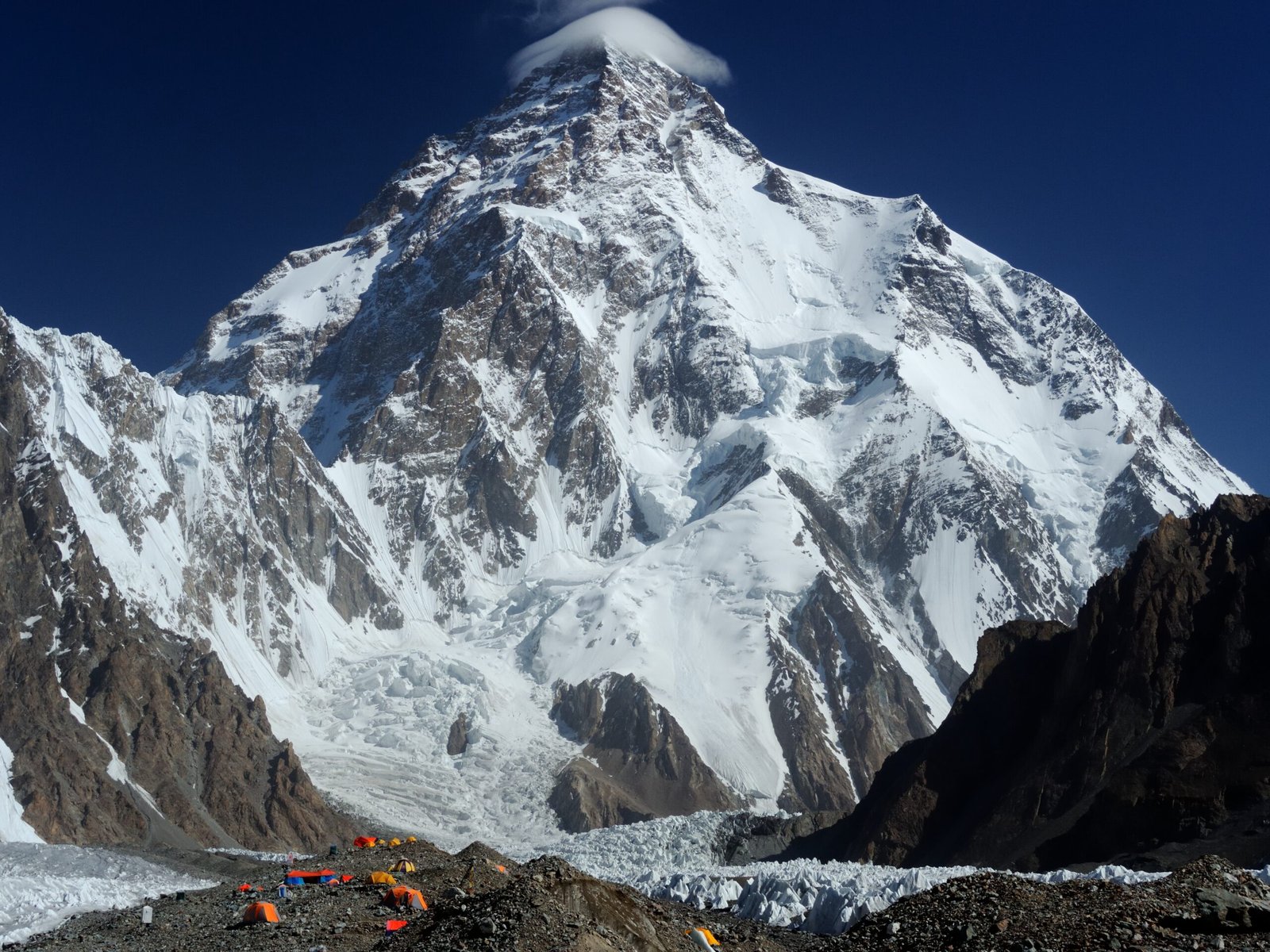
A K2 expedition is one of the most serious undertakings in mountaineering. The mountain stands 8,611 metres (28,251 feet) high, second only to Everest, and it is the highest peak in the Karakoram. The climb takes place on the Pakistan–China border, with the standard route on the Pakistani side in Gilgit-Baltistan, above the Godwin-Austen Glacier. People who search for a K2 expedition are usually trying to understand three things: how high and hard the mountain is, which route teams actually use, and when a summit attempt is realistic.
The short answers are these. K2 is steeper and less forgiving than Everest, the usual line is the Abruzzi Spur, and the useful weather window is narrow, generally sought in July and August. The rest of this guide explains what that means on the ground.
Height and location
K2’s commonly given height is 8,611 metres. It lies in the Karakoram, not the Nepal Himalaya, and it is also known as Mount Godwin-Austen, after an early surveyor. The label K2 itself comes from the Great Trigonometrical Survey, which numbered prominent Karakoram peaks. The mountain later acquired another name, the Savage Mountain, after George Bell of the 1953 American expedition described it as a peak that tries to kill you. The phrase has lasted because the climbing remains objectively dangerous even in a modern, well-supported season.
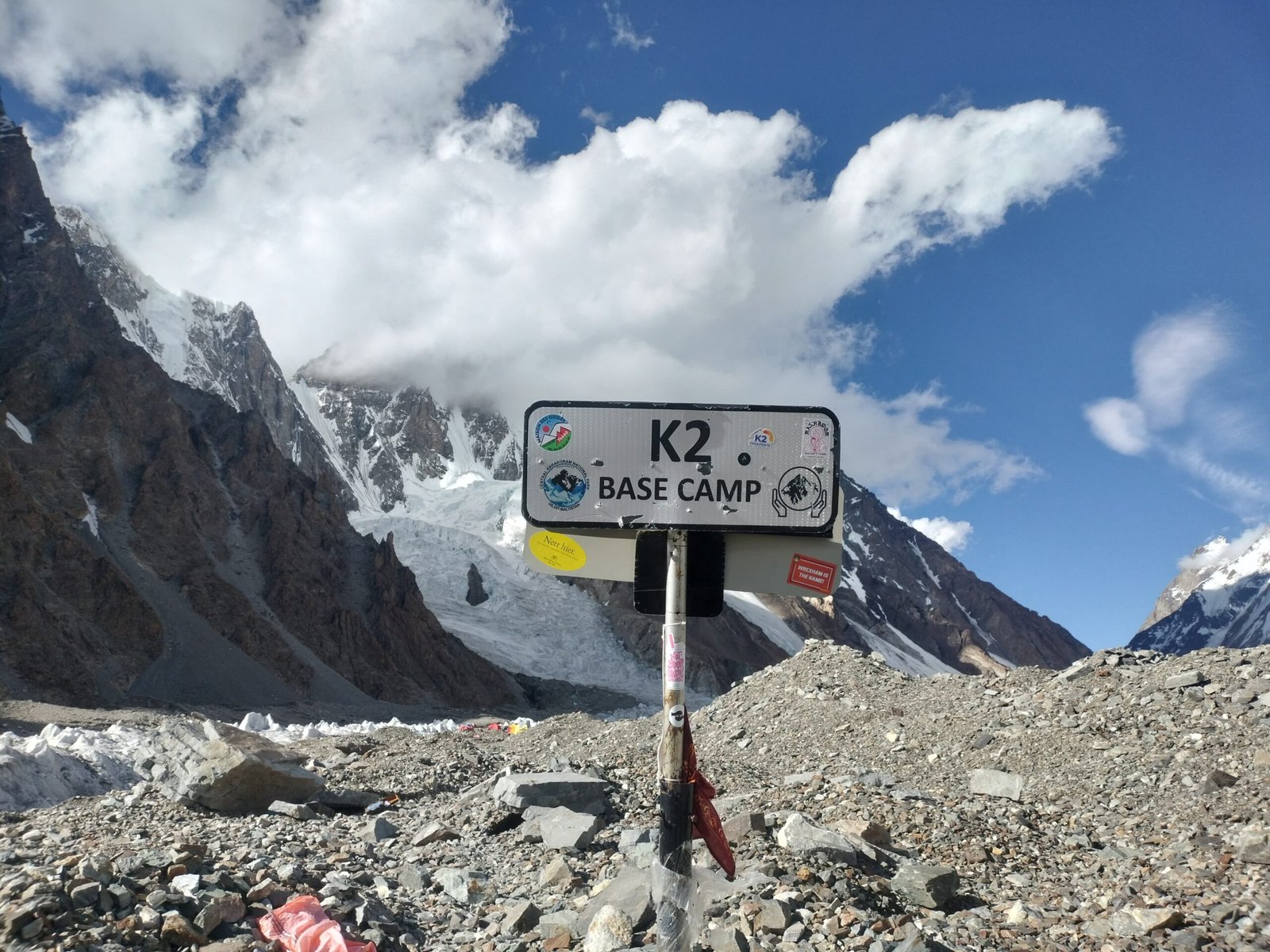
From the south, the peak rises above the Baltoro and Godwin-Austen glaciers. Base camp on a standard Pakistani-side expedition is typically placed around 5,150 metres, after the long walk from Askole through Concordia, where K2 finally appears in full beside Broad Peak and the Gasherbrums.
The Abruzzi Spur, the standard route
Most K2 expeditions climb the Abruzzi Spur, the mountain’s southeast ridge. The line was reconnoitred in 1909 by the expedition of Prince Luigi Amedeo, Duke of the Abruzzi, which reached around 6,250 metres and identified the ridge as the most practical way up. The spur itself is usually considered to begin near 5,400 metres, where advanced base camp is often sited.
Above that, the route is a mixture of rock ribs, snow and ice, and several well-known technical features. House’s Chimney and the Black Pyramid are the major steps on the lower and mid mountain. Higher still, just below 8,000 metres, comes the Bottleneck: a steep couloir beneath hanging seracs. That passage, and the traverse that follows, is where many of the mountain’s worst accidents have occurred, because climbers are exposed both to the difficulty of the terrain and to the risk of falling ice.
Other routes exist, but they are not the normal line for a supported K2 expedition. If you are joining a logistics-supported team from the Pakistani side, you should expect to be on the Abruzzi Spur, or occasionally on a closely related variation on the same southeast face of the mountain.
A short history of the climb
The first ascent was made on 31 July 1954 by Achille Compagnoni and Lino Lacedelli, on an Italian expedition led by Ardito Desio. They reached the summit via the Abruzzi Spur. The expedition included Pakistani members and Hunza support, and it remains one of the landmark climbs of the 20th century. The first winter ascent came much later, on 16 January 2021, when a team of Nepali climbers reached the top — the last of the 8,000-metre peaks to be climbed in winter.
Those dates are part of the mountain’s story, but they should not be read as a promise that the climb has become routine. K2 has always had fewer ascents than Everest, and for many years the number of people who died on the mountain was high relative to the number who summited. More climbers have reached the top in recent seasons, and that historical ratio has eased, but the Bottleneck, the weather, and the steepness of the route have not gone away.
Season, experience and risk
The usual season is summer, with most teams looking for a summit window in July or early August. The useful period of stable weather can be only a couple of weeks. That is why itineraries are long: after the Baltoro approach, climbers need weeks at base camp to acclimatize, fix or use the route, and wait. A typical full K2 expedition from arrival in Islamabad to departure is around seven weeks, including a climbing period of roughly a month.
This is not a first 8,000-metre peak for most people. Teams should already have technical experience at high altitude, ideally including 7,000-metre climbs and, for many members, a previous 8,000-metre mountain such as Gasherbrum II or Broad Peak. Strong movement on steep snow and ice, comfort with fixed ropes, and the judgment to turn around are more important than enthusiasm alone.
The Baltoro approach
Almost every Pakistani-side expedition follows the same path. After Islamabad, climbers fly or drive to Skardu, then travel by jeep to Askole. The walk then leads up the Braldu and onto the Baltoro Glacier, through camps such as Paiju, Urdukas, Goro and Concordia, before the final stage up the Godwin-Austen Glacier to K2 Base Camp. Some teams later leave the mountain over Gondogoro La into the Hushe Valley; others retrace the Baltoro.
Skardu Expedition, based in Skardu, provides the permits, liaison arrangements, transport, porters, kitchen staff and base-camp infrastructure that a K2 team needs before the climbing even begins. The walk-in is not a sightseeing extra. It is the first long test of the expedition, and it is where the team begins to move as a unit.
Frequently asked questions
How high is K2?
K2 is 8,611 metres (28,251 feet) high. It is the second-highest mountain on Earth and the highest in the Karakoram.
When is the best time for a K2 expedition?
Summer is the season, and most summit attempts are made in July or early August, when the chance of a stable window is highest. The exact dates change from year to year.
What experience do you need?
You should already have technical high-altitude experience, generally including 7,000-metre peaks and preferably a previous 8,000-metre climb. K2 is a poor choice as a first expedition at this altitude.
Why is K2 considered more serious than Everest?
The standard route is steeper, the weather window is narrower, the camps are more exposed, and the Bottleneck presents an objective hazard that cannot be organised away. Everest is still a major 8,000-metre climb, but K2 is widely regarded as the harder and less forgiving of the two.