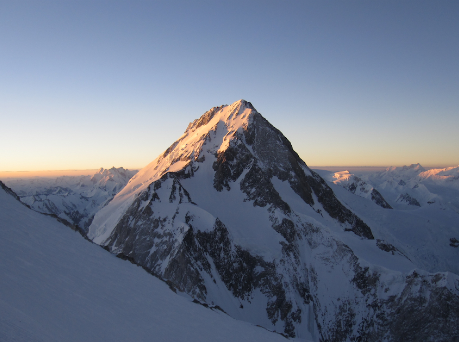
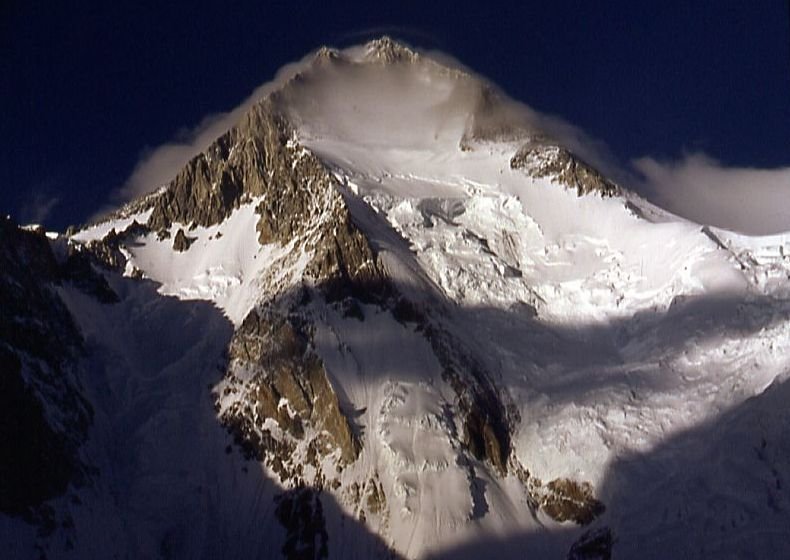
Gasherbrum is not one mountain. It is a tight cluster of high peaks at the head of the Baltoro Glacier, in the Karakoram of Gilgit-Baltistan, on the Pakistan–China border. The name comes from Balti words usually translated as a beautiful or splendid mountain, and the group includes two 8,000-metre summits — Gasherbrum I and Gasherbrum II — plus several slightly lower neighbours that still rank among the great walls of the range.
If you are comparing the two 8,000ers, the distinction matters. Gasherbrum I, also called Hidden Peak, is higher, less frequently climbed, and more technically serious. Gasherbrum II is a little lower and generally regarded as the more approachable of the pair, which is why it is often chosen as a first 8,000-metre peak. Both are reached by the same long walk up the Baltoro, and both are supported from the same corner of the South Gasherbrum Glacier.
The peaks of the Gasherbrum massif
The massif is usually counted as six main summits. The two that draw organised expeditions are the 8,000-metre peaks:
Gasherbrum I (Hidden Peak, also surveyed as K5): 8,080 metres, 11th-highest mountain in the world, and the third-highest in Pakistan after K2 and Nanga Parbat.
Gasherbrum II: 8,035 metres, 13th-highest in the world, and a frequent first 8,000-metre objective in the Karakoram.
Beside them stand Gasherbrum III and the striking Gasherbrum IV, whose west face — the so-called Shining Wall — is one of the most famous rock and ice faces in the range. Gasherbrum IV was first climbed in 1958 by Walter Bonatti and Carlo Mauri. The lower Gasherbrum V and VI complete the group. For most visitors, though, a search for Gasherbrum still leads first to Hidden Peak and its slightly lower twin.
Gasherbrum I, the Hidden Peak
Gasherbrum I earned its English name in 1892, when William Martin Conway’s expedition noted that the summit stays concealed behind nearer ridges for much of the approach along the Baltoro. Even from Concordia, where K2, Broad Peak and the Gasherbrum wall fill the sky, Hidden Peak can remain out of view until the route turns up the South Gasherbrum Glacier.
The first ascent was made on 5 July 1958 by Americans Pete Schoening and Andrew Kauffman, on an expedition led by Nicholas Clinch. It was a landmark climb on what was then the last unclimbed 8,000-metre peak in the Karakoram. Later history added two other chapters that still shape the mountain’s reputation: in 1975 Reinhold Messner and Peter Habeler climbed a new line in alpine style, and on 9 March 2012 Adam Bielecki and Janusz Gołąb made the first winter ascent.
A modern Gasherbrum I expedition is still a serious undertaking. The upper mountain involves steep glaciated terrain and mixed rock-and-ice climbing at high altitude. It is a step above Gasherbrum II in difficulty, and it is not the mountain to choose simply because the two peaks share a base-camp area.
Gasherbrum II, the more frequented 8,000er
Gasherbrum II stands 45 metres lower than its neighbour, at 8,035 metres. It was first climbed on 7 July 1956 by an Austrian team: Fritz Moravec, Josef Larch and Hans Willenpart. Over the following decades it has attracted more traffic than Hidden Peak, in part because the standard route is widely considered less technically demanding, and in part because a successful climb here can serve as a first 8,000-metre experience before a later attempt on a harder Karakoram giant.
That reputation should not be read as easy. Any 8,000-metre climb involves the death zone, avalanche terrain, long summit days and the same narrow weather windows that govern the Baltoro. Gasherbrum II is the more approachable of the two 8,000ers in the massif; it is not a trekking peak.
How expeditions reach the Gasherbrum peaks
Almost every team follows the same corridor. After arriving in Islamabad, climbers fly or drive to Skardu, then travel by jeep through the Shigar Valley to Askole, the last village before the glacier. From Askole the approach is on foot up the Baltoro, through camps such as Paiju, Urdukas and Goro, to Concordia — the great junction often called the throne room of the Karakoram. From there the route leaves the main highway of ice and climbs toward the South Gasherbrum Glacier, where base camps for both 8,000ers are placed.
Skardu Expedition is based in Skardu and supports this approach with permits, transport, porters, kitchen staff and base-camp infrastructure. The walking approach is part of the expedition, not a preamble to be rushed: several days on the Baltoro are needed simply to reach the foot of the mountain in good order.
Which Gasherbrum should you climb?
Choose Gasherbrum II if you want a first 8,000-metre peak in the Karakoram and already have solid high-altitude experience, typically including 7,000-metre climbs and glacier travel. Choose a Gasherbrum I expedition if you have already moved comfortably at extreme altitude and can climb mixed ground on a quieter, more technical 8,000er. Some teams plan both in one season, using the shared base-camp area, but that only makes sense if the team is strong enough for Hidden Peak and if the weather allows two full summit cycles.
In either case, the usual climbing period on the Baltoro is the summer, with most teams on the mountain in June, July and August. Success depends on acclimatization, patience and a clean weather window, not on treating either peak as a formality.
Frequently asked questions
How high is Gasherbrum I?
Gasherbrum I is 8,080 metres (26,510 feet) high. It is the 11th-highest mountain in the world and the third-highest in Pakistan, after K2 and Nanga Parbat.
Is Gasherbrum I harder than Gasherbrum II?
Yes, in general. Gasherbrum I is higher and the standard climbing is more technical, with mixed rock and ice on the upper mountain. Gasherbrum II is still a full 8,000-metre expedition, but it is the more frequently climbed of the two.
Where is the Gasherbrum massif?
The massif stands in the central Karakoram, at the head of the Baltoro Glacier, on the border between Gilgit-Baltistan in Pakistan and Xinjiang in China. Teams approach from the Pakistani side, via Skardu, Askole and Concordia.
When is the climbing season?
Expeditions normally run in summer, with the main activity on the mountain from June through August. The useful summit window in any given year is shorter than that and depends on the weather.