Spantik, also known as Golden Peak, is one of the best-known 7,000-metre mountains in Pakistan. It stands in the Spantik-Sosbun mountains of the Karakoram, in Gilgit-Baltistan, and has a rare combination: a relatively moderate normal route on one side, and a famous, extremely difficult wall on the other. For many climbers, that is why a first serious high-altitude expedition in the Karakoram begins here.
The mountain is high enough to teach the rhythms of a long expedition — travel to Skardu, a glacier approach, high camps, and a summit day in thin air — without the technical severity of Masherbrum, Rakaposhi’s hardest lines, or the 8,000-metre peaks of the Baltoro. Understanding both faces of the mountain helps you decide whether Spantik is the right next step.
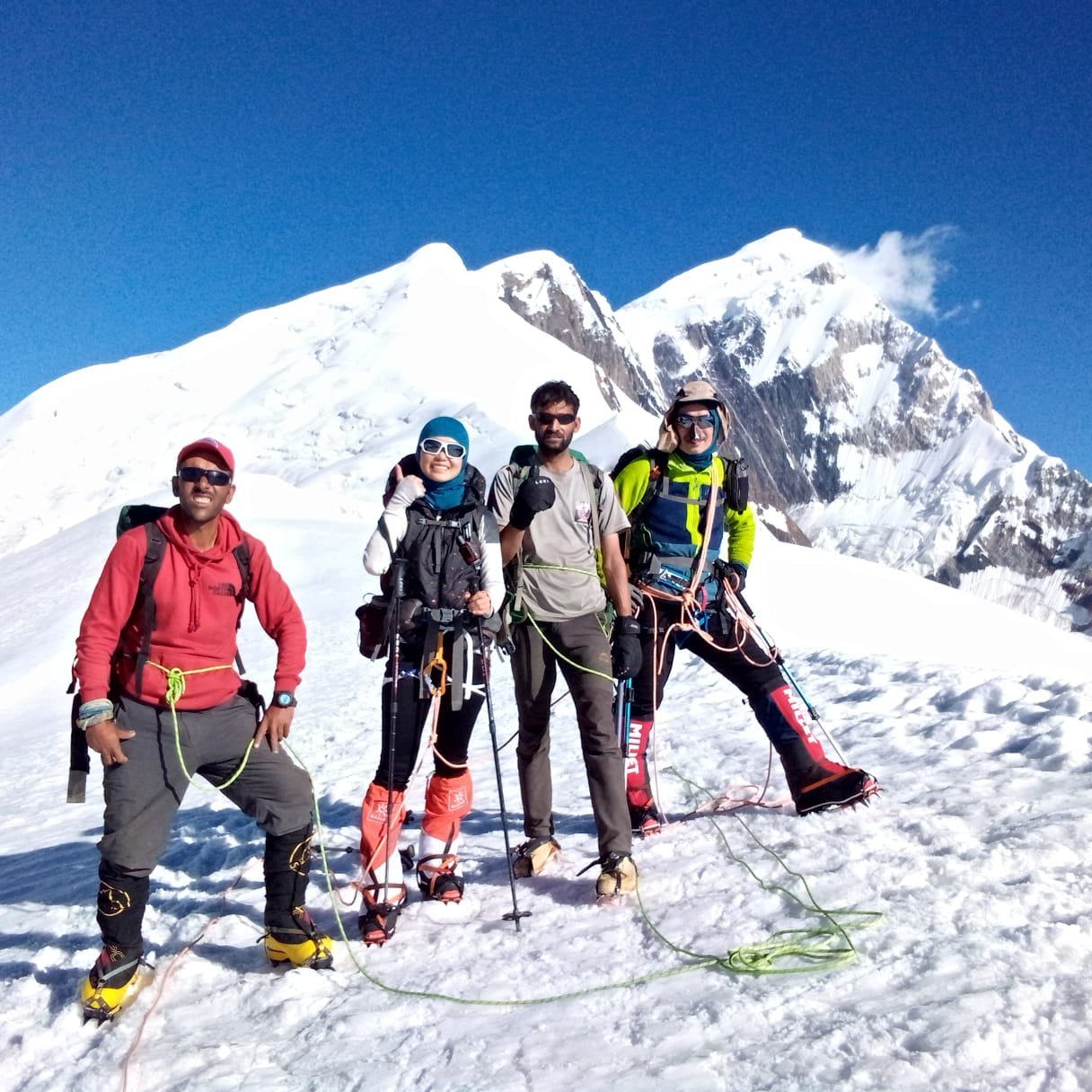
Where is Spantik?
Spantik rises in Gilgit-Baltistan, between the Shigar side of the range and the Nagar valleys. The usual expedition approach comes from Skardu, through the Shigar and Basha valleys, to the village of Arandu at the foot of the Chogo Lungma Glacier. From there, teams trek the moraine to base camp. The mountain can also be reached from the Nagar and Hopar side, though most commercially supported climbs use the Arandu approach.
From high on the ridge, the views take in neighbouring giants such as Diran and the wider western Karakoram. The peak is not on the Baltoro, and that is part of its appeal: you can attempt a genuine 7,000-metre summit without joining the busier trail toward Concordia.
Height and the name Golden Peak
Spantik is 7,027 metres (23,054 feet) high. The name Golden Peak comes from the warm colour the mountain takes in late light, and especially from the great cream-yellow marble wall on the northwest face, known as the Golden Pillar. In Burushaski the mountain has been called Ghenish Chhish, with the same golden meaning. In climbing literature you will also see the Balti name Spantik used for the standard expedition peak.
The first recorded attempt was in 1906, when Fanny Bullock Workman and William Hunter Workman reached high on the mountain but did not summit. The first ascent followed in 1955, when a German team climbed the peak from the Chogo Lungma Glacier. That same general approach — Arandu, the glacier, and the long snow ridge — remains the normal way up today.
The normal route: a classic first 7,000er
The standard route is a long snow ridge rather than a steep technical climb. Slopes are often in the mid-30s, with some sections around 40 to 45 degrees, and the work is mostly glacier travel, cramponing, and steady movement at altitude. That profile is why Spantik is so often recommended as a first 7,000-metre peak, and as a training mountain for climbers who hope to move on to 8,000-metre expeditions.
It is still a real climb. The ridge is long, the air is thin, and weather can close in quickly. Teams typically spend many days on acclimatization rotations between base camp and higher camps before a summit push. Fitness, patience, and sound crampon and self-arrest skills matter more here than advanced rock climbing. A supported Spantik expedition is designed around that rhythm: logistics to base camp, a structured climbing period, and enough time to wait for a clean weather window.
The Golden Pillar is a different mountain
The northwest face is not the route described above. The Golden Pillar is a huge alpine wall of marble and granite, first climbed by Mick Fowler and Victor Saunders in 1987. It is one of the celebrated hard routes of the Karakoram, and it has little in common with the normal snow ridge. If you book a standard expedition, you are coming for the ridge, not for the Pillar. Confusing the two is the most common misunderstanding in a search for Spantik.
The approach from Arandu
After arriving in Islamabad, climbers fly or drive to Skardu, complete packing and permit formalities, then travel by jeep to Arandu. The trek to base camp follows the lateral moraine of the Chogo Lungma Glacier and usually takes a couple of days, with an intermediate camp on the way. Base camp is often placed on a grassy moraine around 4,300 metres, below the climbing ridge.
The best season is generally late June through August, when the approach is in better condition and the ridge is more reasonably in shape. Skardu Expedition handles the road travel, porters, kitchen staff and base-camp setup so that the climbing team can concentrate on rotations and the summit period.
Who should climb Spantik?
Spantik suits mountaineers who already move comfortably on glaciers and have experience at 5,000 or 6,000 metres, whether in Pakistan or elsewhere. It is a poor choice as a first-ever mountain trip, and it is the wrong peak if your goal is a hard technical wall. It is an excellent choice if you want to learn how a 7,000-metre expedition feels — the length of the days, the need to acclimatize, and the discipline of turning around when the weather is wrong — before you commit to a larger objective.
If that is your aim, a Spantik expedition from the Arandu side is one of the most logical starting points in the Karakoram.
Frequently asked questions
How high is Spantik?
Spantik is 7,027 metres (23,054 feet) high. It is also known as Golden Peak.
How difficult is the normal route?
The standard ridge is a moderate high-altitude snow climb, not a hard technical face. The main challenges are length, altitude, weather and glacier travel. The Golden Pillar on the northwest face is a separate, much harder route.
When is the best time to climb Spantik?
Late June through August is the usual season. The exact summit window in any year depends on conditions on the ridge and the weather.
Do you need previous expedition experience?
Yes. Climbers should already have high-altitude trekking or mountaineering experience, ideally on 5,000- to 6,000-metre peaks, and should be comfortable in crampons on glaciated terrain.