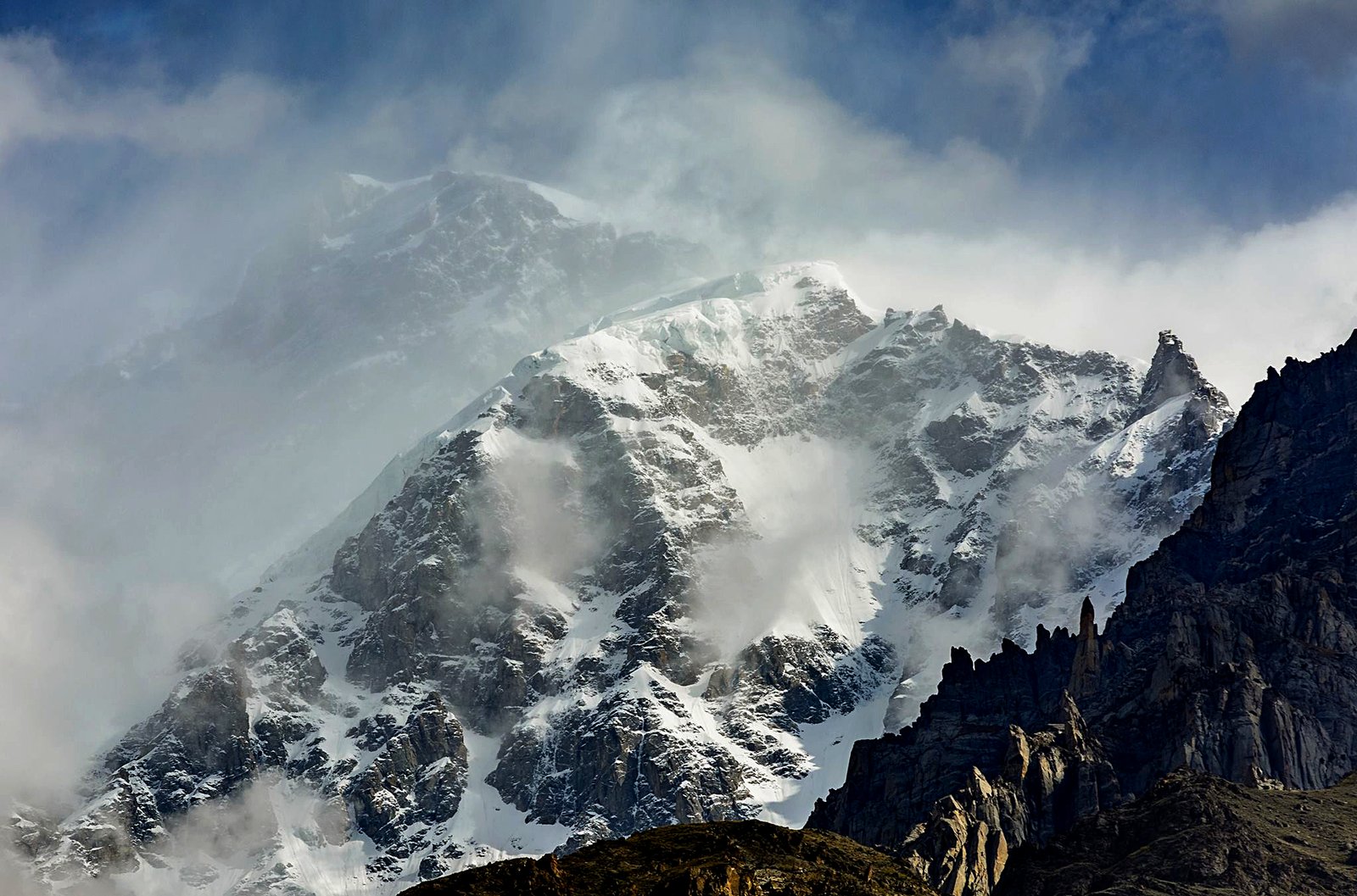
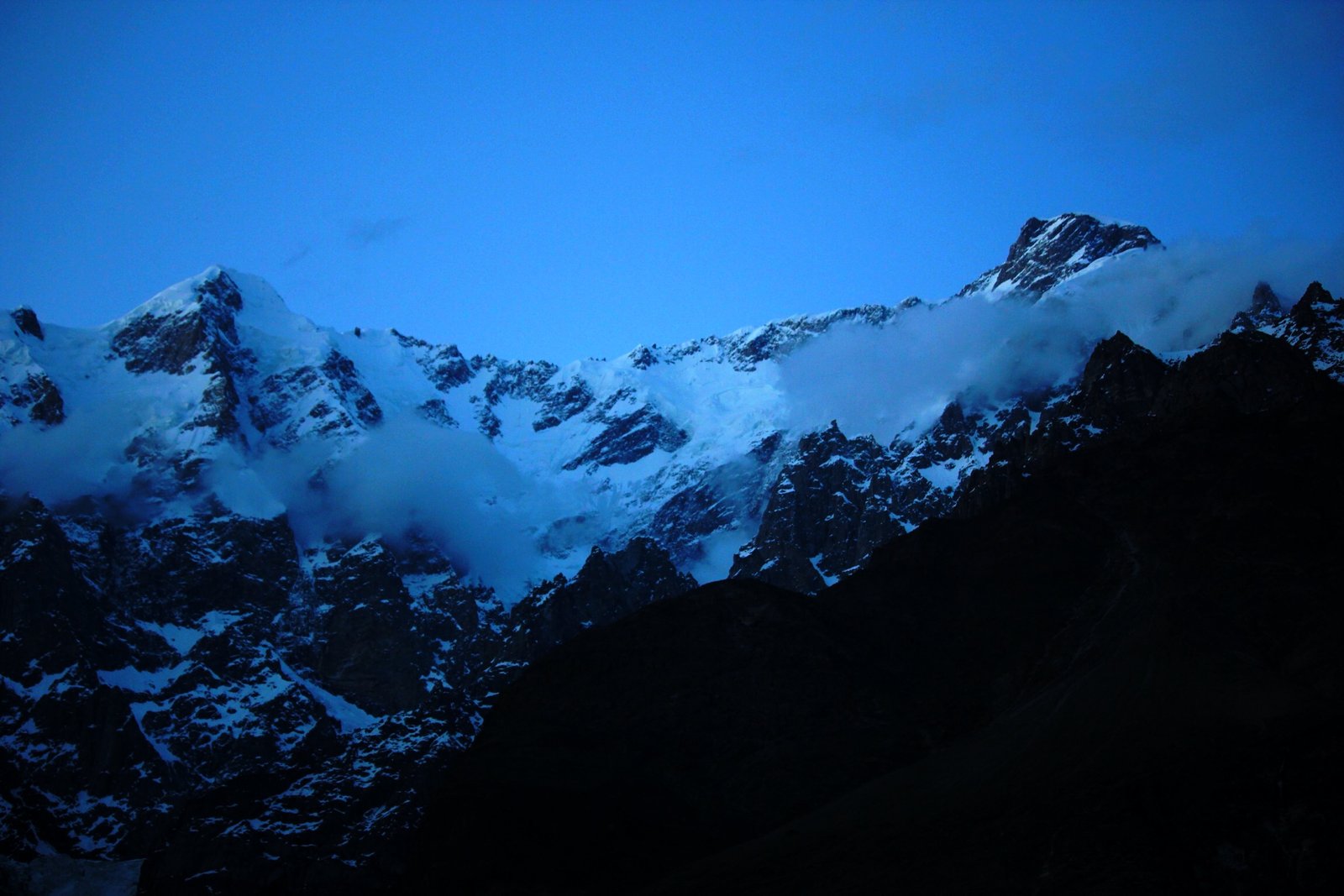
South Ridge / Hunza Wall — 7,388m
Ultar Sar (7,388m), also known as Ultar Peak, is the southeasternmost peak of the Batura Muztagh sub-range in the Karakoram. Rising directly above Karimabad in the Hunza Valley, Ultar Sar features one of the most sheer vertical reliefs in the world, plummeting over 5,000 meters straight down to the valley floor.
Widely regarded by high-altitude alpinists as one of the ultimate tests in mountain sports, Ultar Sar presents severe objective hazards, relentless technical rock and ice, and extreme avalanche exposure. What we offer is complete Base Camp logistics support — Islamabad-to-Base-Camp transport, government permits, local porter management, a dedicated Liaison Officer, kitchen crew, and Base Camp infrastructure — for world-class alpine teams equipped to attempt this legendary peak.
The Hunza Massif
Ultar Sar (7,388m) | Ladyfinger Peak / Bublimotin (6,000m) | Passu Sar (7,478m) | Bojohaghur Duanasir A (7,329m)
Route & Climbing History: Ultar Sar was historically one of the most notorious unclimbed 7,000m peaks in the world, rejecting dozens of international expeditions due to catastrophic avalanche risk and technical rock walls. The mountain was first successfully summitted on July 11, 1996, by a Japanese expedition led by Akihira Hasegawa (summiteers: Yamazaki Akihito and Matsuoka Kiyoshi) via the Southwest Ridge. It remains extraordinarily dangerous and infrequently summitted.
Climbing grade: Extreme high-altitude mixed and alpine climbing (ED+/ABO) — continuous steep ice, vertical rock bands above 6,000m, acute avalanche paths, and high exposure. Intended strictly for elite, world-class technical climbers.
Climbing Equipment and Gear List
Mountain climbing Gears
❏ Helmet ( Black diamond, Petzel )
❏ Alpine Ice Axe (65-70cm)
❏ A mountaineering harness, with adjustable leg loops.
❏ Carabiners: 3 locking and 6 regular
❏ Rappel device: ATC or figure 8
Mountaineering boots
❏ Mountaineering boots suitable for above 6000m; La Sportiva Gsm2 or equivalent
❏ Hiking shoes for the trek to base camp with ankle protection
❏ Gaiters
❏ Thermal mountaineering socks or equivalent: 6 pairs
❏ Liner socks or equivalent: 3 pairs
Body Layers:
❏ 2 merino base layers: top / bottom set
❏ 1 mid layer top: breathable Underwear
❏ Lightweight Nylon Pants: 1 pair
❏ Hooded Soft Shell jacket To be worn over other layers
❏ Soft Shell Guide Pants: Gore Tex and breathable
❏ Hooded Hard Shell: Gore Tex and breathable
❏ Hard Shell Pants: Gore Tex and breathable, big enough to wear over your guide trousers
❏ Insulated Down Jacket with hood: North Face Himalayan parka or equivalent
❏ Insulated synthetic Pants: Worn primarily when climbing below Camp 2
❏ Long jones equivalent to Rab’s Polartec or equivalent: 2 pairs
Headgear and Hand wear:
❏ Wool hat (ski hat)
❏ Sunhat: To shade your face / neck from the sun on a hot day
❏ Buff: To protect your neck / face from the sun
❏ Under helmet Balaclava
❏ Glacier glasses: Full protection with side covers or wrap around
❏ Ski goggles: To be worn on summit day in the event of high winds
❏ Lightweight synthetic liner gloves: For wearing on a hot day; 2 pairs
❏ Soft shell gloves: To wear for moderate cold / wind
❏ Shell glove with insulated liner: To wear for severe cold / strong wind
❏ Expedition Mitts for bad weather
Personal Gear:
❏ Expedition Backpack: 65L pack should be large enough.
❏ Trekking Backpack: To carry on the trek to base camp. Simple and light.
❏ Sleeping Bag: Rated to at least -40°F. Goose down or synthetic
❏ Compression stuff sacks: 3 large ones; for reducing volume of the sleeping bag, down parka, etc., in your pack.
❏ High Quality sleeping pad (1 for base camp and 1 for high camps): Full length is preferred.
❏ Closed cell foam pad: To be used in conjunction with the inflating pad for warmth and comfort when sleeping.
❏ Trekking poles with snow baskets: Adjustable poles
❏ Cup: Plastic insulated cup for drinking
❏ Bowl: A plastic bowl for eating dinner or breakfast
❏ Spoon: Plastic spoon
❏ Head torch: 1 normal for base camp and 1 with remote battery systems for climbing at night. This will be used whilst climbing at night
❏ Sunscreen: SPF 50 or above
❏ Lip balm with sunblock
❏ Water bottles: 2 wide mouth bottles with 1 liter capacity
❏ Water bottle parkas (2): fully insulated with zip opening
❏ Thermos: 1 litre (buy a good ones to keep your water warm for longer hours)
❏ Pee bottle: 1 litre minimum bottle for convenience at night in the tent
❏ Toiletry bag: Include toilet paper and hand sanitizer and small towel
❏ Hand warmers & toe warmers
❏ Pen Knife or multi tool (optional)
❏ Camera: bring extra batteries and memory cards
❏ Personal solar charging system (optional but recommended)
❏ Travel Clothes
❏ Duffel bags (2) with locks: To transport equipment
❏ Base Camp extra Items: Kindle, I pad, books, smart phone, etc
❏ Snack food: Please bring a few days of your favourite climbing snack food such as bars, energy gels, nuts, beef jerky, etc. A variety of salty and sweet is recommended to give you extra energy.
❏ Small personal first aid kit: Include athletic tape, Band-Aid’s, Ibuprofen, blister care, personal medications, etc
❏ Medications and Prescriptions: Bring antibiotics (Azithromycin, etc.), and altitude medicine such as Diamox and dexamethasone
Arrive in Islamabad & Expedition Briefing
⛰ 540m
Our team will receive you at Islamabad International Airport with a name placard and transfer you to your hotel. Share flight details.
🏠 Grand Islamabad / Envoy Hotel or equivalent
Fly Islamabad → Gilgit (or Drive via KKH)
⛰ 1,500m | ⏱ 45 min flight (or 10–12 hrs drive)
Scenic morning flight over Nanga Parbat to Gilgit. (If weather delays the flight, travel overland via the Karakoram Highway to Chilas/Gilgit). Drive to Karimabad, Hunza.
🏠 Hunza Serena Inn / Darbar Hotel or equivalent, Karimabad
Karimabad (Hunza) — Final Preparations & Sightseeing
⛰ 2,400m | ⏱ Rest / Preparation day
Final gear check, food sorting, and team assembly overlooking the Baltit Fort. Staff finalize porter bookings and local clearances.
🏠 Hunza Serena Inn / Darbar Hotel or equivalent, Karimabad
Trek Karimabad → Ultar Meadow (Base Camp)
⛰ 3,800m | 📍 8 km | ⏱ 4–5 hours
Trek up the dramatic Ultar Gorge, ascending alongside the glacier stream to establish Ultar Base Camp in the high alpine meadow directly beneath Ladyfinger Peak and Ultar Sar's South Face.
🏕 Ultar Base Camp (3,800m)
Climbing Period — Acclimatization, Scouting & Summit Push
⛰ 3,800m – 7,388m | ⏱ 22 days
Begins with camp setup and a traditional prayer ceremony. The team conducts reconnaissance, sets up advanced camps/bivouacs along the ridge or face line, and monitors frozen snowpack conditions. When a tight, clear window opens, the team commits to the alpine-style summit push to 7,388m before descending back to Base Camp for cleanup.
⛺ Ultar Base Camp / High Bivouacs
Base Camp Pack-Up & Trek to Karimabad
⛰ 2,400m | ⏱ 3–4 hours
Pack down Base Camp according to strict leave-no-trace protocols. Trek down the Ultar Gorge to Karimabad village.
🏠 Hunza Serena Inn / Darbar Hotel or equivalent, Karimabad
Drive Karimabad → Gilgit
⛰ 1,500m | ⏱ 2–3 hours drive
Short scenic drive down the Hunza Valley to Gilgit. Rest, hot showers, and celebratory team dinner.
🏠 Serena Hotel or equivalent, Gilgit
DAY 29 | Fly Gilgit → Islamabad (Contingency Drive)
⛰ 540m | ⏱ 45 min flight
Morning flight to Islamabad. (If flights are delayed by mountain weather, travel overland via KKH to Islamabad).
🏠 Grand Islamabad / Envoy Hotel or equivalent
De-briefing & International Departure
⏱ Breakfast included
Official de-briefing at the Ministry of Tourism / Alpine Club of Pakistan. Transfer to Islamabad International Airport for homebound flights.
✈ Departure — transfer to airport
Affiliated with & Licence