LATEST
K2 Summer Expeditions 2026 — Now Accepting Bookings New Trek Added: Batura Glacier — Gilgit Zone Government Verified & Registered Agency · Skardu, GB 24/7 Customer Support · WhatsApp: +92 341 153 7783 Best Price Guarantee on All Packages Winter K2 Expedition Season · December – February K2 Summer Expeditions 2026 — Now Accepting Bookings New Trek Added: Batura Glacier — Gilgit Zone Government Verified & Registered Agency · Skardu, GB 24/7 Customer Support · WhatsApp: +92 341 153 7783 Best Price Guarantee on All Packages Winter K2 Expedition Season · December – February

Shipton Spire Expedition

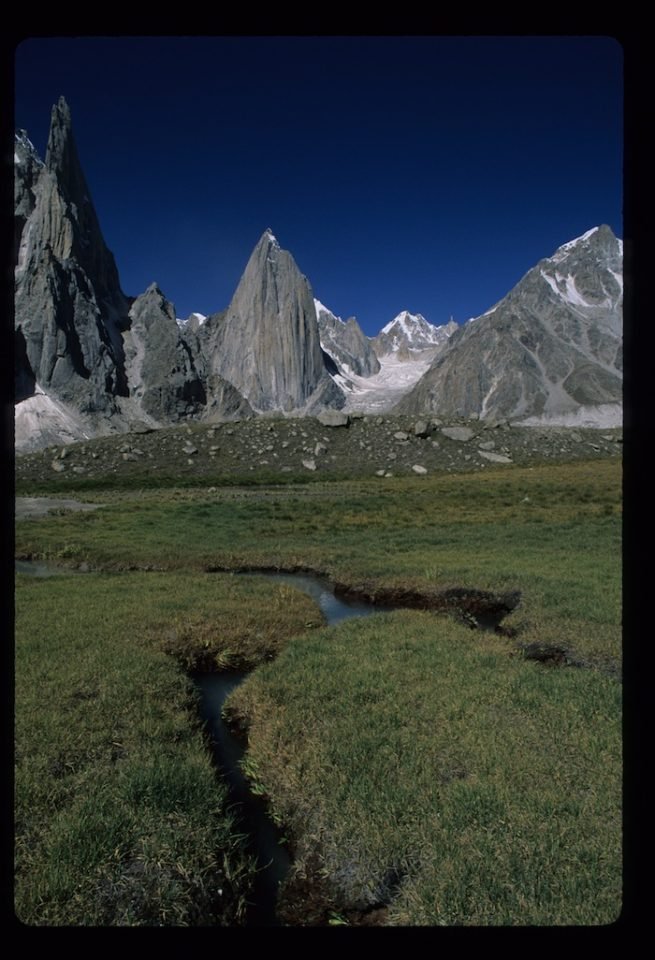
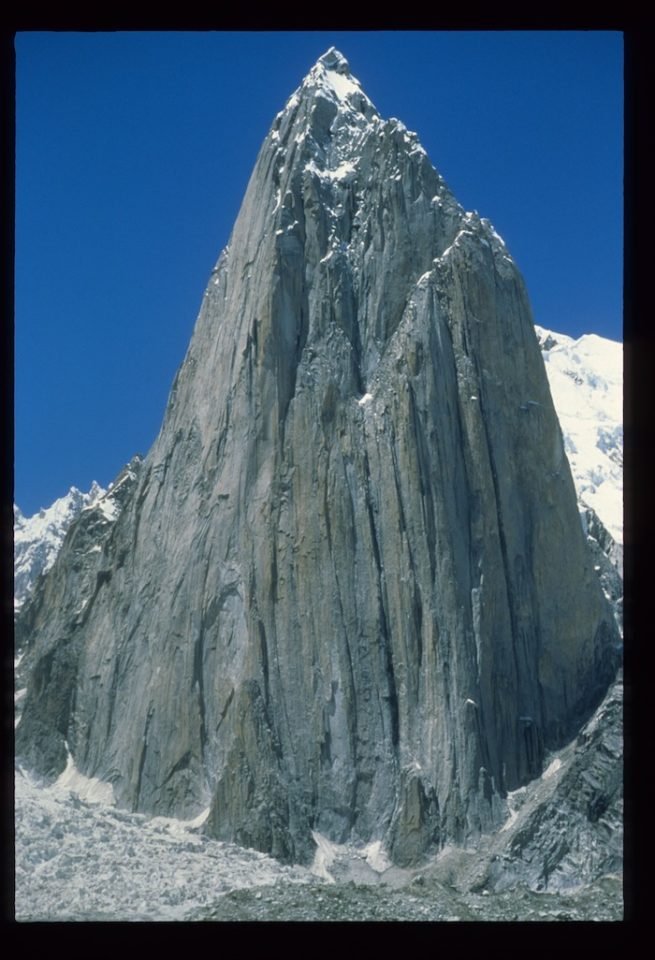
Rising dramatically from the southern rim of the upper Baltoro Glacier, Shipton Spire (6,310 m / 20,700 ft) is a vertical needle of granite that stands as one of the most imposing technical big-wall challenges in the Karakoram range. Located in the legendary Trango group alongside Cathedral Tower and Trango (Nameless) Tower, the spire bears the name of Eric Shipton—the pioneering British explorer whose mid-20th-century expeditions helped map these wild high-altitude landscapes.

What sets Shipton Spire apart is its purely vertical nature. Like its regional neighbor Amin Brak in the Nangma Valley, tackling Shipton Spire isn’t about trekking through snowfields or crampon work; it’s a pure big-wall objective demanding relentless crack climbing, complex aid technique, heavy hauling, and days spent living off portaledges.

A Historic Ascent The peak etched its name in modern alpine history in 1996 when American climbers Greg Child, Mark Synnott, and Jared Ogden completed the first ascent via the Southeast Face. Their route, Ship of Fools, put the spire on the global map and remains the gold-standard line for elite teams targeting the mountain, even as newer lines have since been opened across its faces.

The Expedition Challenge Climbing at 6,310 meters combines high-altitude hypoxia with extreme technical difficulty. Reaching the wall requires a 6-day trek from Askole up the Baltoro Glacier corridor—a journey that offers views of 8,000-meter giants like K2, Broad Peak, and the Gasherbrums, but also exposes teams to volatile weather. Funneled through the glacier valley, sudden summer storms frequently force climbers into multi-day holds on their ledges.

To navigate these demands, local operators like Skardu Expedition Treks & Tours Pakistan handle the extensive groundwork—managing Islamabad permits, coordinating porter teams out of Askole, and setting up base camp logistics and emergency support so climbers can focus entirely on the wall.

Day 1
Arrive at New Islamabad International Airport. Transfer to hotel. Team welcome briefing with Skardu Expedition Treks & Tours. Gear inspection and manifest reviewed. Evening rest — optional visit to Faisal Mosque and Daman-e-Koh viewpoint.
Day 2
Option A: Domestic PIA flight to Skardu (~45 minutes) through one of the world's most spectacular mountain corridors — Nanga Parbat, Haramosh, and the Karakoram horizon visible from the aircraft. Option B: Drive ~11–12 hours north via the Karakoram Highway to Chilas if the Skardu flight is cancelled due to weather. Overnight at destination.
Day 3
Option A (in Skardu): Acclimatization and preparation day. Visit Kharpocho Fort, Satpara Lake, Shigar Fort, and the Skardu bazaar. Formal permit briefing at Ministry of Tourism Skardu regional office — LO assigned, environmental deposit lodged, porter insurance confirmed. Porter contracts finalised and loads weighed. Option B (driving): Drive ~5–6 hours from Chilas north to Skardu. Overnight hotel Skardu.
Day 4
Drive from Skardu south along the Shigar River valley to Askole — the last permanent village before the Baltoro glacier and the traditional starting point for all Baltoro expeditions. Approximately 4–5 hours by jeep through the stark Braldu valley gorge. Porter loads distributed. Overnight guesthouse at Askole. Final food purchases at Askole market.
Day 5
First trekking day on the classic Baltoro trek, departing Askole along the Braldu River. The trail traverses the lower Baltoro moraine, crossing the Braldu on a bridge before ascending through rocky terrain. Dramatic first views of the Trango group and distant ice peaks. Distance ~19 km. Camp at Jhola on the river bank.
Day 6
The trail continues along the Braldu valley, entering the upper gorge below the Baltoro glacier snout. Paiyu — a lush, grassy oasis of trees beside the river — is the last significant green camp before the glacier. The Paiyu Peak massif dominates the skyline above. Distance ~22 km. Camp at Paiyu.
Day 7
Mandatory rest day at Paiyu for acclimatization and porter rest. The team makes short hikes above Paiyu camp toward the glacier moraines for altitude conditioning. Outstanding views of the Trango Towers group — Cathedral and Shipton Spire — from the Paiyu hillsides. Doctor conducts SpO2 assessments. Loads sorted for the glacier section.
Day 8
The trek enters the Baltoro glacier proper — one of the longest glaciers outside the polar regions. Walking on the glacier moraine requires careful footing; the terrain is rough but the views are extraordinary. The Trango group — Cathedral, Trango Tower, and the imposing profile of Shipton Spire — grows dramatically as the team progresses up the glacier. Distance ~13 km. Camp at Liligo.
Day 9
Trek along the upper Baltoro glacier to Urdukas — a rocky ledge camp with famous views across the glacier to the Trango Towers and the first clear sightlines of K2's distant silhouette. The Shipton Spire dominates the southern rim of the glacier above. Distance ~12 km. Camp at Urdukas.
Day 10
Final approach to Shipton Spire Base Camp, diverging from the main Baltoro trek and ascending toward the base of the Spire's walls. The approach to BC crosses the lower Trango glacier and gains the lateral moraine below Shipton Spire's Southeast and Southwest faces. Base Camp established at approximately 4,100–4,300 m on the moraine, with the Spire's extraordinary walls — 2,000+ metres of near-vertical granite — rising directly above. Porters paid and dismissed. Doctor conducts altitude health assessments.
Day 11-31
These days are reserved for climbing.
Day 32
Full rappel descent of the route, stripping fixed lines and protection as the team descends. All gear retrieved to Base Camp. Medical checks and celebration at BC. Equipment breakdown begins.
Day 33
Trek from Shipton Spire Base Camp back down the Baltoro glacier to Urdukas. Final views of the Spire from below on the return. Camp at Urdukas.
Day 34
Continue the Baltoro descent to Paiyu's welcome greenery. Hot tea from the Paiyu camp staff. Camp at Paiyu.
Day 35
Final trekking day back to Askole village. Porter wages settled at Askole. Jeep waiting for Skardu transfer. Long day but downhill — the Braldu valley on the return is familiar and the team moves well.
Day 36
Drive from Askole back to Skardu along the Shigar valley. Hot shower, celebration dinner, and team debrief at hotel. LO paperwork and permit documentation submitted to the Ministry of Tourism Skardu office. Environmental compliance certification filed. Overnight hotel Skardu.
Day 37
Official debriefing with the Ministry of Tourism Skardu representative and Pakistan Alpine Club.
Day 38
Option A: PIA domestic flight from Skardu to Islamabad (~45 minutes). Option B: Drive from Skardu to Chilas (~5–6 hours) if the flight is cancelled. Overnight hotel Islamabad or Chilas.
Day 39
Option A (arrived Islamabad Day 38): Rest and sightseeing day — Faisal Mosque, Lok Virsa Museum, Daman-e-Koh. Final gear dispersal. Option B: Drive ~11–12 hours south from Chilas to Islamabad via KKH and Hazara Expressway.
Day 40
Transfer to New Islamabad International Airport. All team members depart for home destinations. Expedition services formally conclude. End of Shipton Spire Expedition 2025.


ITEM QTY NOTES
Rock Shoes (high-performance) 2 pairs Primary pair for free pitches; backup pair for rest steps; La Sportiva Solution, Scarpa Instinct, or equivalent
Approach / Descent Shoes 1 pair Stiff-soled approach shoe for BC, moraine travel, and rappel descents; La Sportiva TX4 or similar
Climbing Harness (big-wall) 1 Padded wall harness with multiple gear loops for extended hanging belays; Petzl Sequoia or BD Forge recommended
Helmet (CE/UIAA certified) 1 MANDATORY — rockfall constant on Shipton Spire’s walls; MIPS preferred; Petzl Sirocco or BD Vision
Belay Device (assisted-braking) 1 Petzl Grigri or Trango Cinch for wall lead belays; essential for hanging belay management
Tube-Style Belay / Rappel Device 1 ATC or Petzl Reverso for rappels and multi-anchor abseils; backup to Grigri
Ascenders / Jumars (pair) 1 pair Petzl Basicor or CMC; jugging fixed lines on lower and mid wall; retreat hauling
Locking Carabiners (assorted) 12–16 HMS, oval (for aiders), and D-shape screw-gate; generous supply for a 30-pitch wall route
Non-locking Carabiners 20–28 High quantity for racking cams, nuts, pitons on each lead pitch; budget generously
Daisy Chains (per climber) 2 Metolius or BD; for aiders and wall positioning — essential aid hardware
Aiders / Etriers (per climber) 2 sets 5-step nylon or Dyneema; for the varied crack systems of Shipton Spire’s faces
Fifi Hook 2 Quick clip-in on aid placements; essential wall tool
Chest Harness (wall use) 1 For ascender attachment when jugging fixed lines; Petzl chest harness
Chalk Bag & Chalk Full supply Essential for free sections; liquid chalk recommended for humid conditions on the Baltoro
Crack Gloves / Fingerless Gloves 1–2 pairs Hand protection on wide-crack hauling and rope-intensive sections; BD crack gloves
Knee Pads 1 pair Recommended for chimney and wide-crack stemming sections on Shipton Spire’s lower wall
Sports Tape (1-inch rigid) 10+ rolls Finger taping before every crack climbing session is essential on a 30-day wall campaign; budget very generously
Headlamp + Lithium Batteries 2 Pre-dawn starts and late-evening pitches are standard on big-wall pushes; BD Spot or Petzl Tikka
Sunglasses (Category 3–4) 2 pairs Baltoro glacier UV reflection from below is intense; spare essential above BC
Sun Hat & Warm Hat 1 each Wide-brim for daytime wall exposure; beanie for cold portaledge nights above 5,000 m
Insulated Jacket (light down) 1 For hanging belays and portaledge nights; Patagonia Micro Puff or similar — not an expedition suit
Wind Shell Jacket & Pants 1 set Waterproof/windproof layer for Baltoro storm weather on the wall
Base Layers (moisture-wicking) 2–3 sets Merino or synthetic; for active climbing days and cold wall bivouac nights
Approach / Climbing Pants 2 Durable, articulated; Prana Stretch Zion or BD Crag pants recommended for crack climbing
Q1: What is Shipton Spire and why is it celebrated in the world of technical climbing?
Shipton Spire (6,310 m / 20,700 ft), also historically referenced as Shingo Shipton Spire, is one of the most visually spectacular and technically celebrated granite towers in the Karakoram range, located in the upper Baltoro glacier corridor of Shiger district, Baltistan, Gilgit-Baltistan, Pakistan. Named after the legendary British explorer, mountaineer, and author Eric Shipton — whose explorations of the Karakoram, Everest, and the great ranges of Central Asia defined an era of Himalayan exploration — the Spire rises as a near-vertical granite needle from the Baltoro glacier's southern rim, its upper tower narrowing to a dramatically pointed summit that is visible from dozens of kilometres along the glacier. The Spire stands among the Trango Towers group — Cathedral, Trango Tower, and Nameless Tower (Trango Tower Pillar) — in one of the most concentrated collections of extreme granite climbing objectives in the world. Its position in the Baltoro corridor places it within visual range of K2, Broad Peak, the Gasherbrums, and the full sweep of the world's greatest concentration of 8,000 m peaks, giving its summit one of the most extraordinary panoramas available from any technical rock summit on Earth. Like Amin Brak in the Nangma valley, Shipton Spire is fundamentally a granite big-wall objective rather than an alpinism peak — a tower whose technical demands are primarily those of sustained crack climbing, aid climbing, and portaledge management at altitude.
Q2: What is the climbing history of Shipton Spire?
Shipton Spire attracted the attention of the international climbing community from the first expeditions to document the Trango group in detail. The tower's first ascent was achieved in 1996 by an American team comprising Greg Child, Mark Synnott, and Jared Ogden via the Ship of Fools route on the Southeast Face — a landmark ascent that established the Spire's credentials as one of the great technical big-wall objectives in the Karakoram and brought the team significant recognition in the alpinism community. Following the first ascent, successive expeditions developed additional routes on the Spire's various faces: the Southeast, Southwest, and West faces have all seen significant route development by elite teams from Europe, North America, and elsewhere. The 1996 Ship of Fools route remains one of the most sought-after lines on the Spire. The Trango group's broader climbing history — including the extraordinary routes on Trango Tower (Nameless Tower) and Cathedral — has made the Baltoro's southern granite wall one of the defining landscapes of modern extreme alpinism, and Shipton Spire occupies a central place in that history.
Q3: How does Shipton Spire differ from Amin Brak as a big-wall objective?
Shipton Spire and Amin Brak share the fundamental character of granite big-wall objectives — both require portaledge management, aid and free climbing competence, haul systems, and extended time on the wall — but differ in several meaningful ways. Shipton Spire is higher (6,310 m vs. Amin Brak's 5,895 m), which increases the altitude component of the challenge and brings the upper wall into the zone where AMS, HACE, and HAPE become meaningful risks, particularly on a portaledge camp above 5,500 m. The Baltoro glacier approach to Shipton Spire is substantially longer than the Nangma valley approach to Amin Brak — 6 days of glacier trekking versus 2–3 days of valley trekking — making the total expedition duration and physical commitment considerably greater. The Baltoro's weather environment is also more severe than the Nangma valley: the glacier corridor channels wind and weather systems from the surrounding giants, and storm events on the Baltoro tend to be more intense and longer-lasting than those in the sheltered Nangma valley. The Trango group setting gives Shipton Spire an unmatched position for panoramic views — from the summit, K2, Broad Peak, and the full Baltoro panorama are visible in a way that Amin Brak, set in its valley, cannot match. In terms of technical climbing character, both towers feature continuous crack systems on Karakoram granite; Shipton Spire's faces tend toward sustained verticality with sections of overhanging terrain on the upper tower.
Q4: What is the Ship of Fools route and is it the standard line today?
The Ship of Fools route on Shipton Spire's Southeast Face, established by Greg Child, Mark Synnott, and Jared Ogden in 1996, is the first ascent line and remains the most historically significant and most frequently attempted route on the Spire. The route ascends the Southeast Face via a sustained series of crack systems, face sections, and the narrowing upper tower, deploying a combination of free climbing on the continuous crack features and aid climbing on the blanker or more technically committing sections. The route grade reflects sustained commitment over a large number of pitches at altitude — the upper sections of the Spire, where the tower narrows and the crack systems become less obvious, require the most careful route-finding and the most creative protection placement of the entire ascent. Teams planning to attempt the Ship of Fools route should study the 1996 expedition's published accounts in the American Alpine Journal and subsequent ascent reports, and should conduct thorough binocular reconnaissance from Base Camp before committing to the lower wall. Conditions on the route vary significantly from year to year depending on the amount of ice in the crack systems — a drier year with cleaner cracks will favour free climbing, while a colder year with ice-filled cracks may push the team toward a higher proportion of aid.
Q5: What permits and administrative requirements apply to Shipton Spire?
Shipton Spire (6,310 m) is administered by Pakistan's Ministry of Tourism and the Pakistan Alpine Club (PAC) under the standard Pakistan expedition permit framework. As a peak in the 6,000–6,500 m bracket, the royalty permit fee is approximately USD 500–800 per climber depending on current Ministry of Tourism fee schedules. Formal permit briefings are conducted at the Ministry of Tourism Skardu regional office. A government-appointed Liaison Officer is mandatory; all LO expenses — transport, accommodation, equipment, and expedition meals — are the team's responsibility. Critically for a Baltoro big-wall expedition: environmental compliance on the Baltoro glacier is strictly enforced, with heavy fines for teams that do not pack out all human waste from the wall. WAG bags and poop tubes are mandatory equipment, and the environmental deposit is conditional on a clean departure certification. The Baltoro approach also requires compliance with the Gilgit-Baltistan environmental regulations covering campfire use, waste disposal, and porter welfare. Applications should be submitted through a registered Pakistani expedition operator — Skardu Expedition Treks & Tours Pakistan has extensive experience with Baltoro and Trango group expedition logistics — at least 3 months before the planned expedition start date.
Q6: What is the Baltoro glacier approach like and how does it differ from other approaches in this guide series?
The Baltoro glacier approach to Shipton Spire Base Camp is the longest and most physically demanding approach of any objective in this guide series — 6 trekking days from Askole to Base Camp, covering approximately 90 kilometres of terrain that progresses from the Braldu valley gorge through the lower and upper Baltoro moraine to the base of the Trango group. This approach is itself one of the great classic treks in the world: the Baltoro glacier corridor, with its succession of major peaks visible at every turn — Paiyu Peak, the Trango Towers, Cathedral, the Lobsang Spires, Uli Biaho, and eventually K2 and Broad Peak at Concordia — is a landscape of mountain grandeur unmatched anywhere on Earth. The approach is significantly more physically demanding than the Nangma valley approach to Amin Brak or the Charakusa approach to K7: the glacier moraine walking requires constant attention to footing, and the elevation gain from Askole (3,015 m) to BC (c. 4,200 m) is accompanied by the cumulative fatigue of six days of loaded trekking. Teams should arrive in Pakistan well-rested and aerobically fit — the Baltoro approach is not a recovery phase but a demanding physical undertaking in its own right. The scenery, however, is without equal in the climbing world.
Q7: What rock quality and climbing conditions can teams expect on Shipton Spire?
Shipton Spire's granite is generally considered to be among the finest in the Trango group — compact, well-featured with defined crack systems, and offering a satisfying range of free and aid climbing terrain across its various faces. The Baltoro's position on the south side of the main Karakoram divide means the Trango group's south-facing walls receive significant sun exposure, which tends to keep the rock dry and relatively clean on the lower and mid-face sections during the summer season. However, the upper tower sections — above approximately 5,500 m — can carry ice in the cracks from snowfall that lingers at altitude; crack condition should be assessed during the first wall reconnaissance before committing to the upper pitches. The granite's crystal structure on the Spire's faces tends to favour beak, knifeblade, and small cam placements on the thin crack and seam sections, with a progression to hand and fist crack terrain on the wider features. The blank or near-blank sections between crack systems require copperheads and skyhook placements on edge features — teams should carry a generous supply of both. Rock quality assessment on each pitch before committing to a protection placement is essential, as localised zones of exfoliated or fractured granite can occur even on otherwise sound faces.
Q8: What is the best season and weather pattern for Shipton Spire?
The optimal climbing season for Shipton Spire is June through late July, consistent with the broader Baltoro glacier climbing season. The Baltoro corridor is famous among climbers for its afternoon convective cloud build-up, which typically develops by 1:00–2:00 PM and can bring snowfall at higher elevations before clearing in the evening. Morning weather tends to be the most stable window — a characteristic that shapes all Baltoro big-wall strategy. July is the premier month: the longest daylight hours maximise daily pitch progress, the overnight freeze keeps the upper crack systems consolidated, and the frequency of extended multi-day storm events is lower than in August. The Baltoro glacier's enclosed corridor character can create localised wind and precipitation patterns that differ from broader Baltistan weather forecasts; teams should observe local weather for the first week at Base Camp before establishing their wall-weather patterns. August brings increased monsoon-influenced precipitation and more frequent storm events; September post-monsoon attempts are possible but significantly colder temperatures make portaledge bivouacs above 5,000 m more demanding. Budget at least 7–10 days of storm-waiting time within the wall-phase schedule — Baltoro weather is notoriously variable and multi-day holds on the portaledge are the norm rather than the exception.
Q9: What experience level is required for Shipton Spire?
Shipton Spire demands the highest combined level of big-wall technical skill and high-altitude experience of any rock climbing objective in this guide series — exceeding even Amin Brak in total commitment because of the longer approach, higher altitude, and more severe Baltoro weather environment. Prerequisite experience includes: multiple prior multi-day big-wall ascents (at minimum 3–5 days on the wall on routes of Grade VI difficulty), full proficiency in aid climbing to A3 standard including copperheads, beaks, and skyhook placements, portaledge setup and storm-fly management in high-wind conditions, haul system operation across multiple pitches, prior high-altitude experience above 5,500 m, and free climbing ability to 5.11 or above for efficient movement on the continuous crack systems. Teams should also have experience managing extended storm holds on a portaledge — the psychological and logistical demands of 3–5 days pinned on the wall in a Baltoro storm must be understood and accepted before the expedition begins. This is a peak for alpinists at the elite end of the big-wall discipline, comparable to attempting a new route on El Capitan combined with an altitude expedition to a serious Karakoram peak.
Q10: What are the emergency management options from Shipton Spire Base Camp and on the wall?
Emergency management for a Shipton Spire expedition requires planning at both Base Camp and on-wall levels. Base Camp (approximately 4,100–4,300 m) is on the Baltoro glacier, approximately 6 trekking days from Askole and 10–11 days from Skardu. Ground evacuation from BC to Askole takes 4–5 days under normal conditions; from Askole, jeep transport connects to Skardu in 4–5 hours. Pakistan Army Aviation helicopters based in Skardu can potentially reach the Baltoro glacier in clear weather, though wind conditions in the Trango group area can make helicopter operations challenging — the Baltoro corridor's constricted geometry creates significant downdraft hazard for rotary wing aircraft. Landing zones on the glacier near the Trango group must be pre-identified and communicated to Skardu aviation authorities before departure from Askole. On-wall emergencies — climber incapacitation above Camp 1 on the wall — require a technically demanding wall rescue: lowering on fixed lines, haul system reversal, and managed rappel descent to BC terrain before any helicopter or ground evacuation can begin. All teams must pre-plan on-wall rescue protocols for each camp level before beginning the ascent. Satellite phone daily check-ins from the wall to BC are mandatory; PLB activation should be used only when satellite phone communication has failed. Skardu Expedition Treks & Tours Pakistan can coordinate emergency responses via their established network of Baltoro contacts, porter team, and Ministry of Tourism liaison.

Fill up the Form

Inquiry Form

Affiliated with & Licence

Affiliated 1
Affiliated 2
Affiliated 3
Chat with us on WhatsApp
Scroll to Top