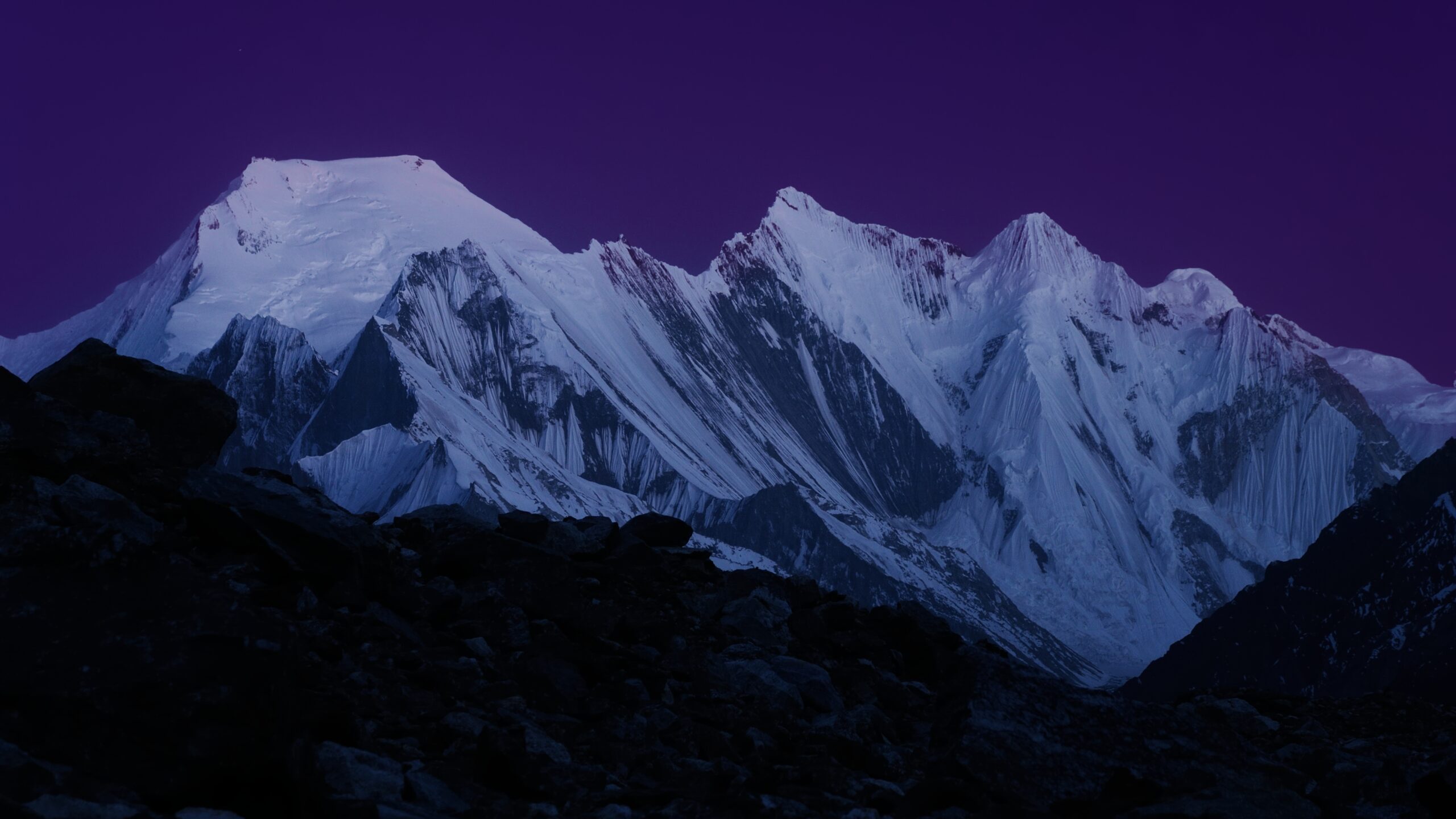
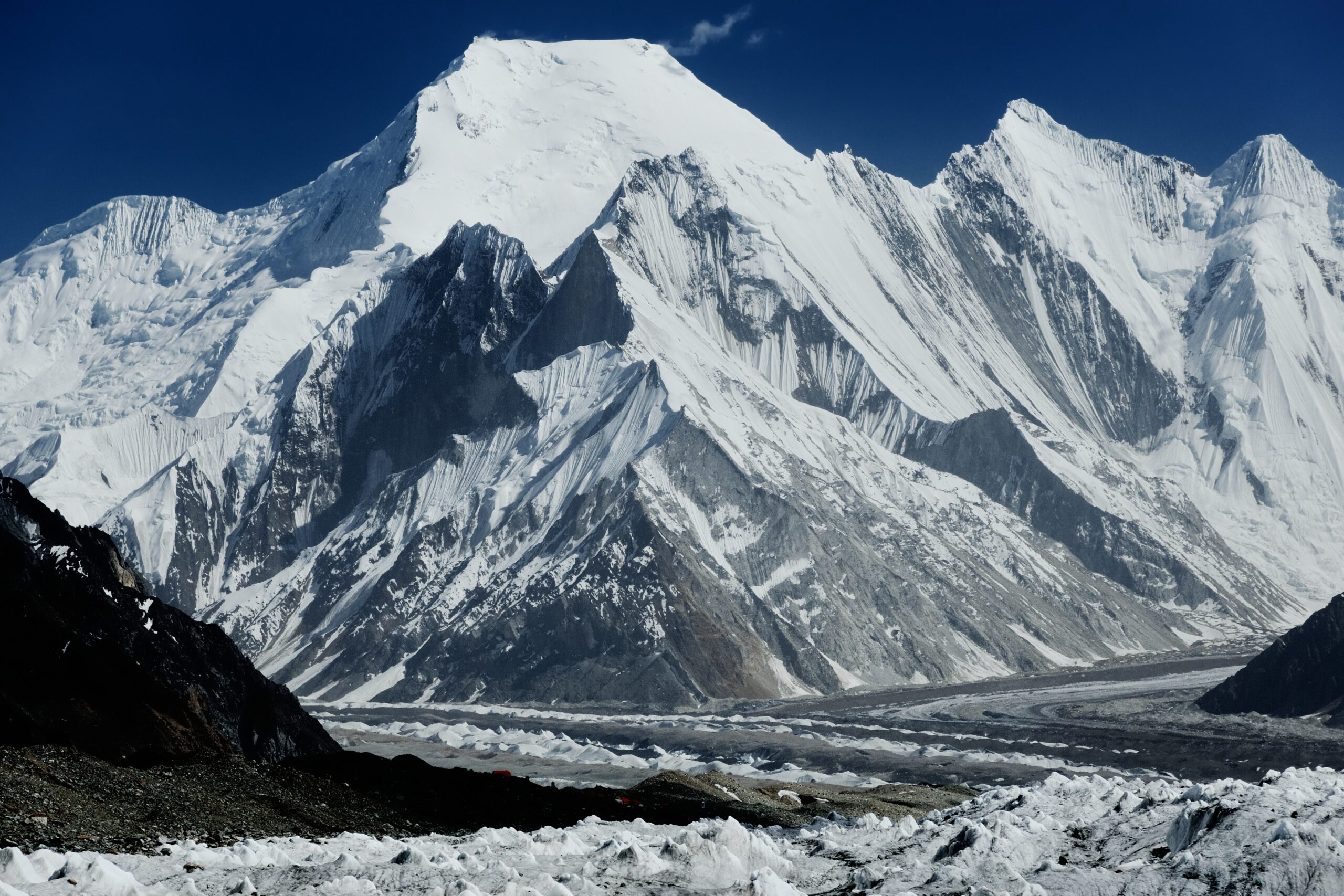
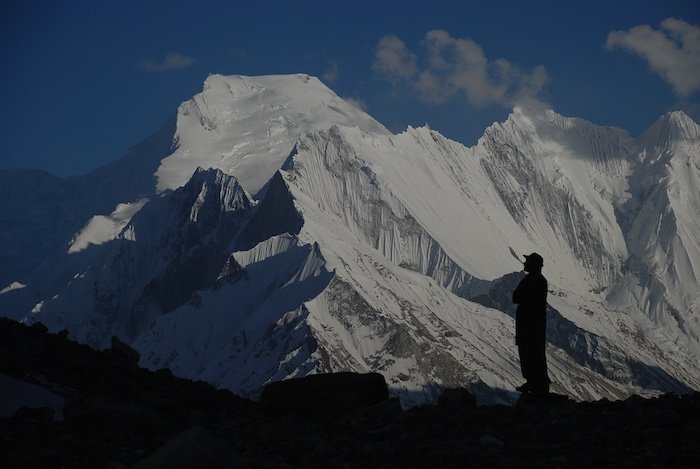
Chogolisa, also known as Bride Peak, is a magnificent mountain massif in the central Karakoram range of Pakistan, located approximately 16 kilometres southeast of K2 near the confluence of the Baltoro and Vigne Glaciers in the Concordia area. The massif has two principal summits: Chogolisa I (7,665 m / 25,147 ft) on the southwest, and Chogolisa II (7,654 m / 25,112 ft) on the northeast. The name Bride Peak was given to Chogolisa II by British explorer Martin Conway during his pioneering Karakoram survey of 1892. The mountain is remarkable not only for its elegant, dome-shaped summit profile — which appears deceptively gentle from Concordia — but for the extraordinary mountain panorama it commands: from the summit, K2, Broad Peak, the Gasherbrums, Masherbrum, and scores of lesser peaks are visible across the Karakoram.
Chogolisa holds a profound and poignant place in the history of Himalayan mountaineering. In June 1909, the celebrated Austrian alpinist Hermann Buhl — who had made the first and solo ascent of Nanga Parbat in 1953 — was attempting the first ascent of Chogolisa II with Kurt Diemberger when he stepped through a cornice in fog near the summit and fell to his death, never to be recovered. The tragedy added a sombre chapter to Chogolisa’s history and established the mountain’s corniced upper ridge as one of the most treacherous terrain features in the range. The first successful ascent of Chogolisa I (the higher summit) was made on 2 August 1975 by an Austrian team; Gustav Ammerer and Fred Pressl reached the summit, guided by expedition leader Eduard Koblmuller, who himself survived a cornice fall during the same attempt by the grace of his rope team. Chogolisa II was first summited in 1958 by a Japanese team from Kyoto University — M. Fujihira and K. Hirai, led by T. Kawabara.
Today, Chogolisa attracts a diverse range of climbers — from highly experienced alpinists seeking a challenging Karakoram 7,000 m objective, to strong trekkers and emerging expedition climbers using it as a high-altitude stepping stone before attempting an 8,000 m peak. The standard route via the Southwest Face and Northwest Ridge offers sustained snow and ice climbing with moderate technical difficulty, but the corniced upper ridge and the death zone altitude above 7,000 m ensure that Chogolisa is never a casual undertaking. Its position beyond Concordia means the approach is identical to the K2 and Gasherbrum expeditions, rewarding climbers with the incomparable Baltoro Glacier scenery en route.
Equipment & Gear List
The following lists represent the minimum recommended equipment for a Chogolisa expedition via the Southwest Face / Northwest Ridge. The gear requirements closely parallel those of Broad Peak and Gasherbrum II, with particular emphasis on snow anchoring equipment for the corniced upper ridge. No rock protection rack is required on the standard route. Personal pack weights at Base Camp should not exceed 22 kg.
1. Clothing & Footwear
| Item | Qty | Notes |
| Down Suit (7,500 m+ rated) | 1 | Essential for summit day and C3; 800 fill power minimum |
| Hard Shell Jacket & Pants | 2 sets | Waterproof/windproof Gore-Tex; essential for Baltoro storms and upper ridge wind |
| Softshell Jacket & Pants | 1 set | Mid-elevation climbing and camp use |
| Mid-Layer Fleece / Down Jacket | 2 | Insulation layer for Base Camp and lower camps |
| Base Layers (thermal top & bottom) | 3 sets | Moisture-wicking merino wool or synthetic; change after each rotation |
| Gloves: Liner / Mid / Expedition Mitts | 1 pair each | Three-layer glove system; critical on Chogolisa’s corniced summit ridge |
| Balaclava & Neck Gaiter | 2 each | Wind protection above 7,000 m on the exposed upper Southwest Ridge |
| Warm Hat & Wide-Brim Sun Hat | 1 each | Beanie for cold camps; wide-brim for Baltoro glacier approach |
| High-Altitude Boots (7,500 m+ rated) | 1 pair | Double boots e.g. La Sportiva Olympus Mons or Millet Everest |
| Trekking / Approach Boots | 1 pair | For Baltoro glacier approach trek to Chogolisa Base Camp |
| Camp Booties (insulated) | 1 pair | For inside tents at high camps |
| Gaiters | 1 pair | Essential on upper snow slopes and summit ridge cornices |
| Trekking Socks (wool/synthetic) | 6 pairs | Thick for high altitude; thinner pairs for approach trek |
| Sunglasses (Category 4) | 2 pairs | Glacier UV extreme on Vigne Glacier approach; always carry a spare |
2. Climbing Hardware
| Item | Qty | Notes |
| Climbing Harness (expedition) | 1 | Must fit over bulky down suit; test before departure |
| Ascender / Jumar (pair) | 1 pair | For fixed-rope ascent on Southwest Face and upper ridge |
| Belay / Rappel Device (ATC or Figure-8) | 1 | For rappel descents on the upper face |
| Locking Carabiners | 8–10 | Mix of screw-gate and auto-locking |
| Non-locking Carabiners | 8–10 | Clipping fixed lines and running protection |
| Ice Axe (technical curved pick) | 1–2 | One technical axe; one straight axe for glacier approach |
| Crampons (12-point technical) | 1 pair | Anti-balling plates; compatible with 7,500 m boots |
| Helmet (CE/UIAA certified) | 1 | Rockfall and wind-dislodged ice risk on upper Southwest Ridge |
| Trekking Poles (telescoping) | 1 pair | Baltoro approach and high-camp descent support |
| Slings (120 cm & 60 cm) | 4–6 each | For anchor building on snow and mixed sections |
| Prussik Cords (6 mm, 60 cm) | 2 | Self-rescue and crevasse extrication on Vigne Glacier |
| Snow Pickets / Snow Stakes | 4–6 | Team shared; upper glacier and summit ridge anchor systems |
3. Camp & Bivouac Equipment
| Item | Qty/Spec | Notes |
| 4-Season Expedition Tent | 2-person | Wind-rated 80+ km/h; semi-geodesic freestanding preferred |
| Sleeping Bag (-35°C rated) | 1 | For C3 and summit bid; 850+ fill power down |
| Sleeping Bag (-15°C rated) | 1 | Base Camp and lower camps (C1/C2) |
| Insulated Sleeping Pad (R-value 5+) | 2 | Foam + inflatable for redundancy on icy tent platforms |
| Expedition Backpack (70–80 L) | 1 | Load carrying between camps on Southwest Face |
| Summit Pack (25–30 L) | 1 | Lightweight summit day pack; target under 8 kg loaded |
| Expedition Duffel Bags | 2–3 | For porter loads; max 25 kg each to Askole |
| High-Altitude Stove (MSR Reactor / Jet Boil) | 2 | Spare burner essential; test in sub-zero conditions before trip |
| Fuel Canisters | 25–30 | ~3 canisters per camp per rotation; Chogolisa’s 3-camp system |
| Insulated Cooking Pot & Mug | 1 set | Titanium or hard-anodised; insulated mug critical at altitude |
| Headlamp + Spare Batteries (lithium) | 2 headlamps | Pre-dawn summit start; lithium batteries only above 6,000 m |
| Water Bottles (insulated, 1 L wide-mouth) | 2 | Wide-mouth Nalgene; prevents freezing above 6,500 m |
| Water Purification Tablets / Filter | 1 | Lower camps; boil water at altitude |
| High-Calorie Expedition Food | Full supply | Freeze-dried meals, nuts, gels, energy bars for all camps; ~4,000 kcal/day above 6,000 m |
4. Oxygen & Medical Equipment
| Item | Qty | Notes |
| Supplemental Oxygen Cylinders (4L) | 2–4 per climber | Recommended above 7,000 m; mandatory for emergency use |
| Oxygen Regulator + Mask | 1 set + spare | Altitude-rated; flow rate 2–4 L/min on summit day if used |
| Gamow Bag (team, BC) | 1 | Portable hyperbaric chamber; essential for HACE/HAPE emergencies at remote BC |
| Pulse Oximeter | 3 (team) | Monitor SpO2 at every camp; key safety and acclimatization tool |
| Dexamethasone 8 mg injectable | Per protocol | HACE emergency treatment — administer and descend immediately |
| Nifedipine 30 mg extended-release | Per protocol | HAPE emergency treatment — administer and descend |
| Diamox (Acetazolamide) 250 mg | Per protocol | Acclimatization support; prophylactic and therapeutic use |
| SAT Phone + GPS / EPIRB Beacon | 1 each | Emergency communication; EPIRB for location signal in remote Concordia area |
| Ibuprofen, Paracetamol, Co-codamol | Ample supply | Pain management, altitude headache, and fever throughout expedition |
| Oral Rehydration Salts + Loperamide | Ample supply | GI illness is common at altitude; essential for hydration on long glacier days |
Additional Medical Kit (per expedition)
- Ibuprofen 400 mg, paracetamol, co-codamol — pain management, altitude headache, and fever
- Loperamide (Imodium) and oral rehydration salts — GI illness common on long Baltoro expeditions
- Blister and wound kit: moleskin, compeed pads, wound closure strips, antiseptic wipes
- Snowblindness drops: tetracaine for pain relief; antibiotic eye drops for secondary infection
- Frostbite kit: ibuprofen 400 mg, aloe vera gel, non-adherent dressings — fingers and toes at risk on corniced ridge
- Throat lozenges and steam inhaler — high-altitude dry cough universal above 5,000 m on long expeditions
- Sunscreen SPF 50+ and lip balm SPF 30 — glacier UV on Vigne and Baltoro approaches is severe
- Vitamin C, zinc, and iron supplements — immune and endurance support during 49-day expedition
Affiliated with & Licence