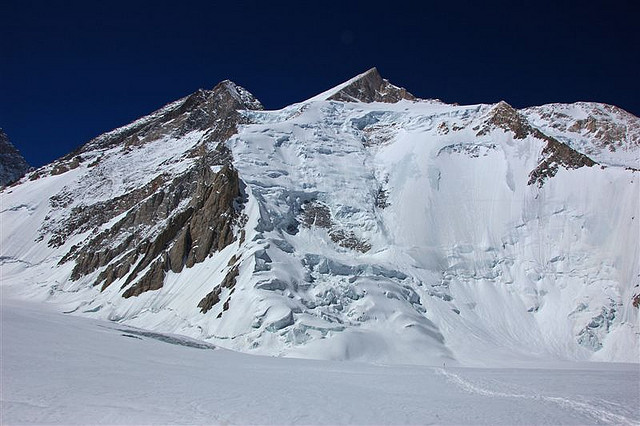
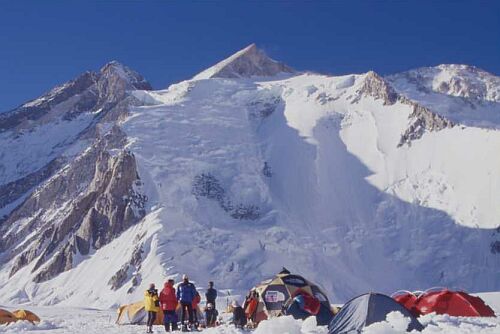
Gasherbrum II (8,035 m / 26,362 ft), also known by its survey designation K4, is the thirteenth-highest mountain on Earth and the fourth-highest peak in Pakistan. Situated in the Gasherbrum massif at the head of the South Gasherbrum Glacier in the central Karakoram range, it straddles the border between Pakistan’s Gilgit-Baltistan region and China’s Xinjiang province. Like its near-neighbour Gasherbrum I, the name derives from the Balti language — rgasha brum — meaning Beautiful Mountain, a testament to the elegance and symmetry that defines the entire Gasherbrum group. The mountain’s most prominent feature as seen from Concordia is its graceful, sweeping Southeast Ridge, which forms the backbone of the standard climbing route and gives the peak its characteristic pyramid silhouette against the Karakoram sky.
Gasherbrum II holds a special place among the world’s 8,000 m peaks as one of the most suitable objectives for an alpinist’s first venture above 8,000 metres. Its standard route — the Southeast Ridge — involves long, sustained high-altitude climbing on moderate to steep snow and ice (averaging 40–50°) without the extreme mixed rock sections, major seracs, or complex route-finding challenges found on technically harder 8,000 m peaks. The summit success rate of approximately 40–45% is among the highest of any 8,000 m peak, reflecting both the route’s relative directness and the quality of weather windows typically available in July. However, these statistics should not encourage complacency: every metre above Base Camp on G-II is in the thin air of high altitude, the summit day spends hours in the death zone above 8,000 m, and the consequences of a weather reversal or altitude illness at Camp 3 are severe.
The first ascent of Gasherbrum II was made on 7 July 1956 by an Austrian team: Fritz Moravec, Josef Larch, and Hans Willenpart, guided by the expedition leader — a significant achievement in the golden decade of Himalayan first ascents. The peak was climbed without supplemental oxygen, following the Southeast Ridge that remains the standard route to this day. A landmark in the mountain’s more recent history was the first winter ascent on 2 February 2011 by Simone Moro, Denis Urubko, and Cory Richards — the first winter summit of an 8,000 m peak by a team that did not include any Nepali climbers, and a journey memorably documented in the film Cold. Today, Gasherbrum II attracts a diverse range of teams and is frequently used as an acclimatization peak before a subsequent G-I or K2 attempt.
Equipment & Gear List
The following lists represent the minimum recommended equipment for a Gasherbrum II expedition via the Southeast Ridge. G-II’s predominantly snow and ice terrain requires a slightly leaner hardware rack than G-I, with no rock protection needed on the standard route. Personal pack weights at Base Camp should not exceed 22 kg.
1. Clothing & Footwear
| Item | Qty | Notes |
| Down Suit (7,000 m+ rated) | 1 | For summit day and Camp 3; 750–800 fill power minimum |
| Hard Shell Jacket & Pants | 2 sets | Waterproof/windproof Gore-Tex outer layer; essential for storm days |
| Softshell Jacket & Pants | 1 set | Mid-elevation climbing, camp use, and approach |
| Mid-Layer Fleece / Down Jacket | 2 | Insulation layer for Base Camp and lower camps |
| Base Layers (thermal top & bottom) | 3 sets | Moisture-wicking merino wool or synthetic; change after each rotation |
| Gloves: Liner / Mid / Expedition Mitts | 1 pair each | Three-layer glove system; spare liners recommended |
| Balaclava & Neck Gaiter | 2 each | Wind and cold protection on summit ridge and upper snowfields |
| Warm Hat & Wide-Brim Sun Hat | 1 each | Beanie for cold camps; wide-brim for Baltoro glacier approach |
| High-Altitude Boots (7,000 m+ rated) | 1 pair | Double boots e.g. La Sportiva Olympus Mons or Millet Everest |
| Trekking / Approach Boots | 1 pair | For Baltoro glacier approach trek |
| Camp Booties (insulated) | 1 pair | Inside tent use at high camps |
| Gaiters | 1 pair | Essential on upper snowfields and glacier approach |
| Trekking Socks (wool/synthetic) | 6 pairs | Thick for high altitude; thinner for approach trek |
| Sunglasses (Category 4) | 2 pairs | Glacier UV is severe; always carry a spare pair |
2. Climbing Hardware
| Item | Qty | Notes |
| Climbing Harness (expedition) | 1 | Must fit comfortably over down suit; test fit before departure |
| Ascender / Jumar (pair) | 1 pair | Fixed-rope progress on steeper sections of Southeast Ridge |
| Belay / Rappel Device (ATC or Figure-8) | 1 | For rappel descents on Southeast Ridge |
| Locking Carabiners | 8–10 | Mix of screw-gate and auto-locking styles |
| Non-locking Carabiners | 8–10 | Clipping fixed lines and running protection |
| Ice Axe (technical curved pick) | 1–2 | One technical axe for steep sections; one straight for approach |
| Crampons (12-point technical) | 1 pair | Anti-balling plates; compatible with 7,000 m boots |
| Helmet (CE/UIAA certified) | 1 | Serac and ice debris hazard above C2 |
| Trekking Poles (telescoping) | 1 pair | Glacier approach support and descent stability |
| Slings (120 cm & 60 cm) | 4–6 each | For anchor building and clipping fixed protection |
| Prussik Cords (6 mm, 60 cm) | 2 | Self-rescue, crevasse extrication |
| Snow Pickets / Snow Stakes | 4–6 | Team shared; upper snowfield anchor construction |
3. Camp & Bivouac Equipment
| Item | Qty/Spec | Notes |
| 4-Season Expedition Tent | 2-person | Wind-rated 80+ km/h; semi-geodesic freestanding preferred |
| Sleeping Bag (-30°C rated) | 1 | For C3 and summit night; 800+ fill power down |
| Sleeping Bag (-15°C rated) | 1 | Base Camp and Camps 1 and 2 |
| Insulated Sleeping Pad (R-value 5+) | 2 | Foam + inflatable for redundancy on icy tent platforms |
| Expedition Backpack (70–80 L) | 1 | Load carrying between camps |
| Summit Pack (25–30 L) | 1 | Lightweight summit day pack; aim under 8 kg loaded |
| Expedition Duffel Bags | 2–3 | For porter loads; max 25 kg each |
| High-Altitude Stove (MSR Reactor / Jet Boil) | 2 | Spare burner critical; test in cold conditions before trip |
| Fuel Canisters | 20–25 | ~2–3 canisters per camp per rotation |
| Insulated Cooking Pot & Mug | 1 set | Titanium or hard-anodised; insulated mug essential at altitude |
| Headlamp + Spare Batteries (lithium) | 2 headlamps | Pre-dawn summit departure; lithium cells only above 6,000 m |
| Water Bottles (insulated, 1 L wide-mouth) | 2 | Wide-mouth Nalgene; prevents freezing above 7,000 m |
| Water Purification Tablets / Filter | 1 | For lower camps; boil water at high altitude |
| High-Calorie Expedition Food | Full supply | Freeze-dried meals, nuts, gels, energy bars; ~4,000 kcal/day above 6,000 m |
4. Oxygen & Medical Equipment
| Item | Qty | Notes |
| Supplemental Oxygen Cylinders (4L) | 2–4 per climber | Optional on G-II; strongly recommended above 7,500 m and for emergencies |
| Oxygen Regulator + Mask | 1 set + spare | Altitude-rated regulator; flow 2–4 L/min on summit day if used |
| Gamow Bag (team, BC) | 1 | Portable hyperbaric chamber; essential for HACE/HAPE emergencies |
| Pulse Oximeter | 3 (team) | Monitor SpO2 at every camp; key safety and acclimatization tool |
| Dexamethasone 8 mg injectable | Per protocol | HACE emergency treatment — administer and descend immediately |
| Nifedipine 30 mg extended-release | Per protocol | HAPE emergency treatment |
| Diamox (Acetazolamide) 250 mg | Per protocol | Acclimatization support; prophylactic and treatment use |
| SAT Phone + GPS / EPIRB Beacon | 1 each | Emergency communication and location signalling from any camp |
| Ibuprofen, Paracetamol, Co-codamol | Ample supply | Pain management, headache, and fever at altitude |
| Oral Rehydration Salts + Loperamide | Ample supply | Gastrointestinal illness is common; critical for hydration maintenance |
Additional Medical Kit (per expedition)
- Ibuprofen 400 mg, paracetamol, co-codamol — pain management, headache, and fever
- Loperamide (Imodium) and oral rehydration salts — gastrointestinal illness is common
- Blister and wound kit: moleskin, compeed pads, wound closure strips, antiseptic wipes
- Snowblindness drops: tetracaine for pain relief; antibiotic eye drops for infection
- Frostbite kit: ibuprofen 400 mg, aloe vera gel, non-adherent dressings
- Throat lozenges and portable steam inhaler — high-altitude dry cough is universal
- Sunscreen SPF 50+ and lip balm SPF 30 — glacier UV reflection causes rapid sunburn
- Vitamin C, zinc, and iron supplements — immune and haematological support on long expeditions
| First rotation up the lower Southeast Ridge glacier to Camp 1 on the broad snow shelf. Fix ropes on steeper initial sections. Sleep one night at C1. Return to BC for 2-day rest. |
Affiliated with & Licence