LATEST
K2 Summer Expeditions 2026 — Now Accepting Bookings New Trek Added: Batura Glacier — Gilgit Zone Government Verified & Registered Agency · Skardu, GB 24/7 Customer Support · WhatsApp: +92 341 153 7783 Best Price Guarantee on All Packages Winter K2 Expedition Season · December – February K2 Summer Expeditions 2026 — Now Accepting Bookings New Trek Added: Batura Glacier — Gilgit Zone Government Verified & Registered Agency · Skardu, GB 24/7 Customer Support · WhatsApp: +92 341 153 7783 Best Price Guarantee on All Packages Winter K2 Expedition Season · December – February

Gasherbrum I Expedition

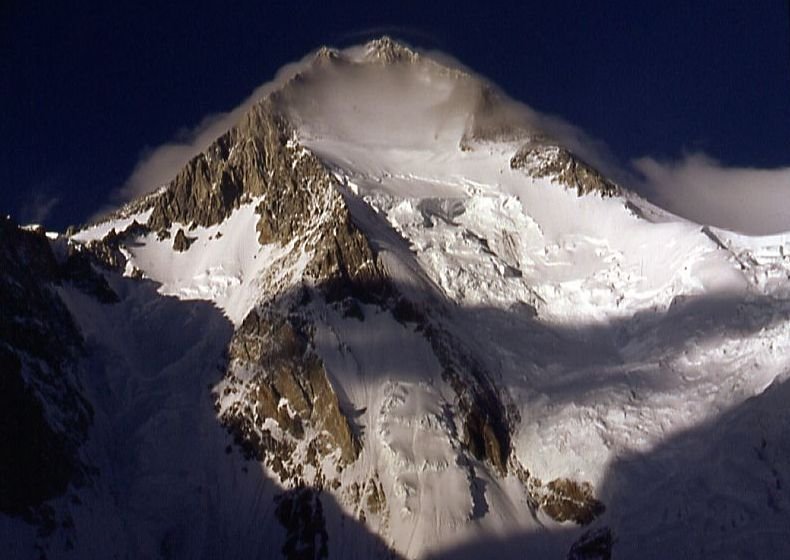
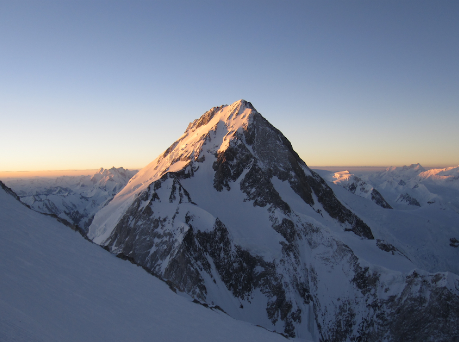
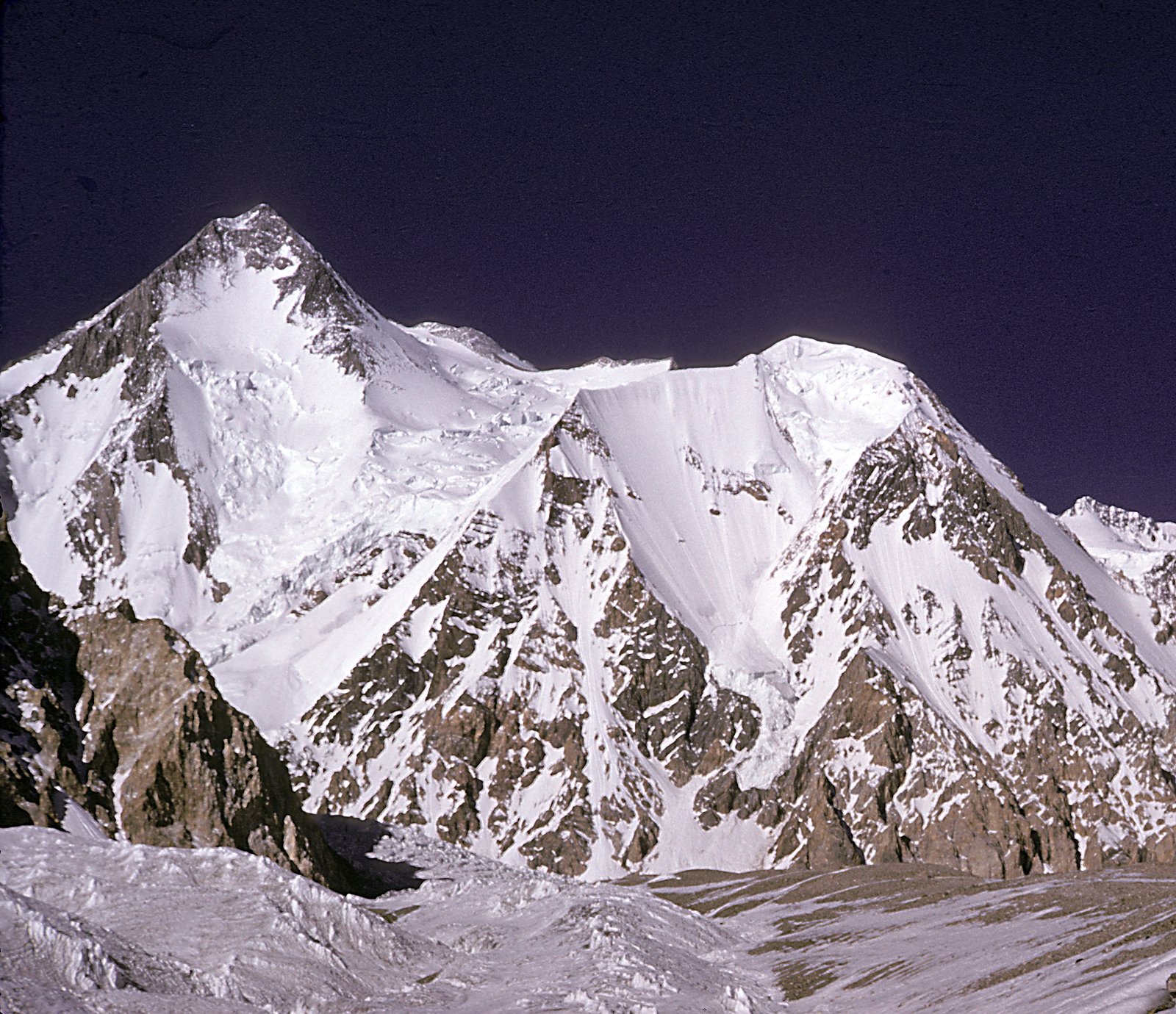
Gasherbrum I (8,080 m / 26,509 ft), also known as Hidden Peak or K5, is the eleventh-highest mountain on Earth and the fifth-highest peak in Pakistan. It stands in the Gasherbrum massif at the head of the South Gasherbrum Glacier in the central Karakoram range, straddling the border of Pakistan’s Gilgit-Baltistan region and China’s Xinjiang province. The name Gasherbrum derives from the Balti words rgasha (beautiful) and brum (mountain), meaning Beautiful Mountain — a fitting description of its elegant and imposing pyramid when viewed from Concordia. The designation Hidden Peak was given by the 1892 Conway Expedition because the summit is not visible from the Baltoro Glacier lower reaches, remaining concealed behind the surrounding ridges until climbers reach the upper glacier.

The mountain is the highest of the six Gasherbrum peaks and shares a Base Camp on the South Gasherbrum Glacier with its neighbour Gasherbrum II (8,035 m), making it a natural partner for a double 8,000 m expedition. The standard ascent route — the Northwest Face (American Route) — was first climbed in 1958 and involves a multi-stage climb through steep glaciated terrain, sustained upper-face couloirs reaching 55–60°, and a critical mixed rock-and-ice crux band at approximately 7,500–7,700 m that demands genuine technical climbing proficiency. Above the crux, a broad summit snowfield leads to the highest point. This technical character places G-I a step above Broad Peak and Gasherbrum II in difficulty, and climbers should arrive with strong ice and mixed climbing skills.

The first ascent of Gasherbrum I was made on 5 July 1958 by Americans Andrew Kauffman and Pete Schoening — the first American team to summit an 8,000 m peak. The climb was a landmark achievement, completed without the use of supplemental oxygen and with a lean, self-sufficient team typical of the best American alpinism of the era. Schoening had already made mountaineering history five years earlier during the 1953 K2 expedition with his legendary belay that arrested the fall of six climbers on the Abruzzi Spur. Today, Gasherbrum I receives fewer visiting teams than K2 or the more famous 8,000 m peaks, preserving a sense of remoteness and adventure that many climbers prize above all.

Equipment & Gear List

The following lists represent the minimum recommended equipment for a Gasherbrum I expedition via the Northwest Face. Note the inclusion of a small rock protection rack for the mixed crux band above 7,500 m — this distinguishes G-I’s gear requirements from Broad Peak and Gasherbrum II. Personal pack weights at Base Camp should not exceed 22 kg.

1. Clothing & Footwear

Item Qty Notes
Down Suit (7,500 m+ rated) 1 Essential for summit day and C3; 800 fill power minimum
Hard Shell Jacket & Pants 2 sets Waterproof/windproof Gore-Tex outer layer for all conditions
Softshell Jacket & Pants 1 set Mid-elevation climbing and camp use
Mid-Layer Fleece / Down Jacket 2 Insulation layer for Base Camp and lower camps
Base Layers (thermal top & bottom) 3 sets Moisture-wicking merino wool or synthetic; change regularly
Gloves: Liner / Mid / Expedition Mitts 1 pair each Three-layer glove system critical on summit day
Balaclava & Neck Gaiter 2 each Wind and cold protection above 7,000 m
Warm Hat & Sun Hat 1 each Wool beanie for cold; wide-brim for Baltoro glacier approach
High-Altitude Boots (7,500 m+ rated) 1 pair Double boots e.g. La Sportiva G2 Evo or Millet Everest
Trekking / Approach Boots 1 pair For Baltoro glacier approach to Base Camp
Camp Booties (insulated) 1 pair For inside tents at high camps
Gaiters 1 pair Snow exclusion on upper face couloirs; essential
Trekking Socks (wool/synthetic) 6 pairs Thick for high altitude; thinner for approach trek
Sunglasses (Category 4) 2 pairs Glacier UV is extreme; always carry a spare

2. Climbing Hardware

Item Qty Notes
Climbing Harness (expedition) 1 Must fit comfortably over bulky down suit
Ascender / Jumar (pair) 1 pair Fixed-rope ascent on steep couloirs above C1
Belay / Rappel Device 1 ATC or Figure-8 for rappel descents
Locking Carabiners 8–10 Mix of screw-gate and auto-locking
Non-locking Carabiners 10–12 Clipping fixed lines and running protection
Ice Axe (technical curved pick) 1–2 One technical axe; one straight for glacier approach
Crampons (12-point technical) 1 pair Anti-balling plates; compatible with 7,500 m boots
Helmet (CE/UIAA certified) 1 Rockfall risk high on G-I’s couloirs and rocky bands
Trekking Poles (telescoping) 1 pair Glacier approach and high-camp descent support
Slings (120 cm & 60 cm) 4–6 each Dyneema for light weight; nylon for abrasion resistance
Prussik Cords (6 mm, 60 cm) 2 Self-rescue and crevasse extrication
Snow Pickets / Deadman Anchors 4–6 Team shared; upper face anchor building
Rock Protection (nuts, hexes) Small rack For the crux mixed band above 7,500 m on standard route

3. Camp & Bivouac Equipment

Item Qty/Spec Notes
4-Season Expedition Tent 2-person Wind-rated 80+ km/h; freestanding semi-geodesic preferred
Sleeping Bag (-35°C rated) 1 For C3 and summit bid; 850+ fill power
Sleeping Bag (-15°C rated) 1 Base Camp and lower camps
Insulated Sleeping Pad (R-value 6+) 2 Foam + inflatable for redundancy on ice platforms
Expedition Backpack (75–85 L) 1 Load carrying between camps
Summit Pack (25–30 L) 1 Ultralight summit day pack; target under 8 kg loaded
Expedition Duffel Bags 2–3 For porter loads; max 25 kg per bag
High-Altitude Stove (MSR Reactor / Jet Boil) 2 Spare burner essential; test in sub-zero before trip
Fuel Canisters 25–30 ~3 canisters per camp per rotation at altitude
Insulated Cooking Pot & Mug 1 set Titanium or hard-anodised aluminium; insulated mug critical
Headlamp + Spare Batteries (lithium) 2 headlamps Pre-dawn summit start; lithium batteries only above 6,000 m
Water Bottles (insulated, 1 L wide-mouth) 2 Prevent freezing; Nalgene wide-mouth preferred
Water Purification Tablets / Filter 1 Lower camps and approach; boil at high altitude
High-Calorie Expedition Food Full supply Freeze-dried meals, nuts, gels, bars for all camps; ~4,000 kcal/day above 6,000 m

3.4 Oxygen & Medical Equipment

Item Qty Notes
Supplemental Oxygen Cylinders (4L) 2–4 per climber Recommended above 7,500 m; mandatory for emergencies
Oxygen Regulator + Mask 1 set + spare Altitude-rated regulator; flow rate 2–4 L/min on summit day
Gamow Bag (team, BC) 1 Portable hyperbaric chamber for HACE/HAPE treatment
Pulse Oximeter 3 (team) Monitor SpO2 at every camp; key safety tool
Dexamethasone 8 mg injectable Per protocol HACE emergency treatment; administer and descend
Nifedipine 30 mg extended-release Per protocol HAPE emergency treatment
Diamox (Acetazolamide) 250 mg Per protocol Acclimatization support; prophylactic and therapeutic use
SAT Phone + GPS/EPIRB Beacon 1 each Emergency communication and location signalling
Ibuprofen, Paracetamol, Co-codamol Ample supply Pain management and fever reduction
Oral Rehydration Salts + Loperamide Ample supply GI illness is common at altitude; critical for hydration

Additional Medical Kit (per expedition)

Ibuprofen 400 mg, paracetamol, co-codamol — pain management and fever

Loperamide (Imodium) and oral rehydration salts — GI illness is common at altitude

Blister and wound kit: moleskin, compeed, wound closures, antiseptic wipes

Snowblindness drops: tetracaine for pain relief, antibiotic eye drops

Frostbite kit: ibuprofen 400 mg, aloe vera gel, non-adherent dressings, iloprost if available

Throat lozenges and steam inhaler — high-altitude dry cough is universal on G-I

Sunscreen SPF 50+ and lip balm SPF 30 — glacier UV exposure is severe

Q1: What is Gasherbrum I and how does it compare to other 8,000 m peaks?
Gasherbrum I (8,080 m) is the eleventh-highest mountain in the world and the fifth-highest in Pakistan, located in the Gasherbrum massif of the central Karakoram. Its name translates from the Balti language as 'Beautiful Mountain.' Despite its relative obscurity compared to K2 or Everest, G-I is a serious and respected 8,000 m objective. Its summit success rate of roughly 30–35% reflects the technical difficulty of the standard Northwest Face route, which involves steep ice couloirs, mixed ground, and a demanding crux rock-and-ice band above 7,500 m. It is frequently paired with Gasherbrum II (8,035 m), which shares its Base Camp, making a double 8,000 m expedition logistically attractive
Q2: What is the standard route on Gasherbrum I?
The standard route is the Northwest Face, also known as the American Route, first climbed in 1958. From Base Camp on the South Gasherbrum Glacier, climbers ascend to the Gasherbrum La (a high col) via steep ice and snow. Above the La, the route traverses onto the Northwest Face, ascending a series of sustained snow and ice couloirs before meeting a crux mixed rock-and-ice band at approximately 7,500–7,700 m. Above this, a steep snowfield leads to the summit pyramid and the highest point at 8,080 m. The route is heavily glaciated and crevasse travel is required between camps.
Q3: When is the best season to climb Gasherbrum I?
The only viable season is the summer window of late June to mid-August. July is typically the most settled period, offering the most stable weather patterns. Like all Karakoram peaks, G-I is subject to rapid weather changes driven by the southwest monsoon. Teams typically monitor MeteoBlue high-altitude forecasts and wait at Base Camp for a 3–5 day summit window. Autumn and winter ascents of G-I are essentially non-existent in the historical record
Q4: What permits are required and what do they cost?
A Royalty Permit from the Pakistan Ministry of Tourism and the Pakistan Alpine Club (PAC) is mandatory. The current permit fee for Gasherbrum I is approximately USD 1,150 per climber. All expeditions must be accompanied by a government-appointed Liaison Officer (LO), whose salary and expenses are the team's responsibility. An environmental deposit (refundable on clean departure) and porter accident insurance are also required. Applications should be submitted at least 3 months before departure.
Q5: Is it possible to combine G-I with Gasherbrum II in a single expedition
Yes, and this is a popular strategy. G-I and G-II share a Base Camp on the South Gasherbrum Glacier and require the same approach trek, so combining them reduces the total logistical cost per summit. A combined expedition typically runs 65–75 days. The standard practice is to use G-II (8,035 m), which is considered slightly less technically demanding, as the first acclimatization summit before attempting G-I. A separate permit is required for each peak.
Q6: How technically difficult is Gasherbrum I?
G-I is more technical than Broad Peak or Gasherbrum II, primarily due to the mixed rock-and-ice crux band above 7,500 m on the Northwest Face. This section requires competent crampon technique on mixed ground, ice-axe use on steep ice (up to 55–60°), and some rock protection placement. Below the crux, the couloirs on the upper face are sustained at 45–50°. The mountain is generally considered more challenging than a 'straightforward' 8,000 m peak but more forgiving than K2's Abruzzi Spur. Strong crampon and ice axe skills are essential.
Q7: Is supplemental oxygen commonly used on G-I?
Gasherbrum I is regularly climbed without supplemental oxygen by experienced alpinists. However, oxygen is recommended for any climber without a prior 7,500 m+ summit, and all teams should carry oxygen for emergency use. The summit day from Camp 3 (7,050 m) to the top (8,080 m) involves over 1,000 m of vertical gain entirely in the death zone, and can take 10–14 hours round-trip. Any deterioration in weather or fitness above 7,500 m makes descent difficult without oxygen support
Q8: What are the main objective hazards on the route?
The primary objective hazards on Gasherbrum I include crevasse falls on the South Gasherbrum Glacier between Base Camp and Camp 1, serac and ice cliff exposure above Camp 2 on the Northwest Face, and wind slab avalanche risk on the upper couloirs after fresh snowfall. The crux mixed band above 7,500 m presents rockfall risk particularly later in the day when the sun loosens frozen rock. Parties should pass exposed sections early in the morning and avoid lingering beneath ice walls.
Q9: How long does the full expedition typically last?
A standard G-I-only expedition from Islamabad arrival to departure runs approximately 48–55 days. This includes the 6-day approach trek to Base Camp, 4–6 weeks on the mountain for acclimatization rotations and summit bids (including weather delays), and the 5-day trek out. Teams pairing G-I with G-II should budget 65–75 days. Weather delays at Base Camp are common and teams should treat any fixed expedition end-date with flexibility.
Q10: What is the cost of a Gasherbrum I expedition?
A fully supported guided expedition to G-I typically costs between USD 12,000 and USD 30,000 per climber, depending on the operator, services, and whether oxygen is included. This covers permits (~USD 1,150), LO fees, porter wages, Base Camp staff, food, and guiding. Independent expeditions can be arranged for USD 8,000–14,000 but require full self-sufficiency, prior 8,000 m experience, and the ability to manage all logistics independently from Skardu
Q11: What altitude illness risks should climbers be aware of?
The primary altitude illness risks on G-I are Acute Mountain Sickness (AMS), High Altitude Cerebral Edema (HACE), and High Altitude Pulmonary Edema (HAPE). The rapid ascent profile on summit rotations requires vigilant daily SpO2 monitoring. Any climber showing symptoms of HACE (confusion, loss of coordination) or HAPE (persistent cough, breathlessness at rest, pink frothy sputum) must descend immediately. The expedition doctor administers dexamethasone for HACE and nifedipine for HAPE as emergency treatment pending descent. The Base Camp Gamow bag provides hyperbaric therapy when descent is temporarily impossible.
Day 1–2: Islamabad Arrival
Arrive in Islamabad. Team briefing, permit collection from Pakistan Alpine Club (PAC), gear inspection and consolidation. Hotel rest and final equipment sourcing.
Day 3: Islamabad → Skardu
Fly to Skardu (2,438 m) or drive via Karakoram Highway (~20 hours). Acclimatization walk around Kachura Lake. Rest and porters pre-arranged.
Day 4–5: Skardu Preparation
Final resupply, porter hiring, and load packing. Medical check and altitude medication briefing by expedition doctor. Visit Sadpara Lake for a short acclimatization walk at ~3,200 m.
Day 6: Skardu → Askole
4–5 hour jeep drive along Braldu River to Askole (3,015 m), the last village. Camp setup. Porter loads sealed and tagged (max 25 kg per load). LO briefing.
Day 7–8: Askole → Jhola & Paju
Trek Day 7 to Jhola (3,110 m) through gorge terrain. Day 8 advance to Paju (3,400 m), with first views of Trango Towers. Cook team establishes camp.
Day 9: Paju Rest Day
Mandatory rest at Paju per PAC regulations. Short hike on moraine ridge for acclimatization. Glacier gear and crampon checks
Day 10–11: Paju → Urdukas & Goro II
Trek across Baltoro Glacier. Day 10: camp at Urdukas (4,050 m) with stunning Cathedral Peaks panorama. Day 11: advance to Goro II (4,300 m).
Day 12: Goro II → Concordia
Arrive Concordia (4,600 m). Spectacular views of K2, Broad Peak, and the Gasherbrum massif. Afternoon rest. First sighting of G-I's imposing North Face
Day 13: Concordia → G-I/G-II Base Camp
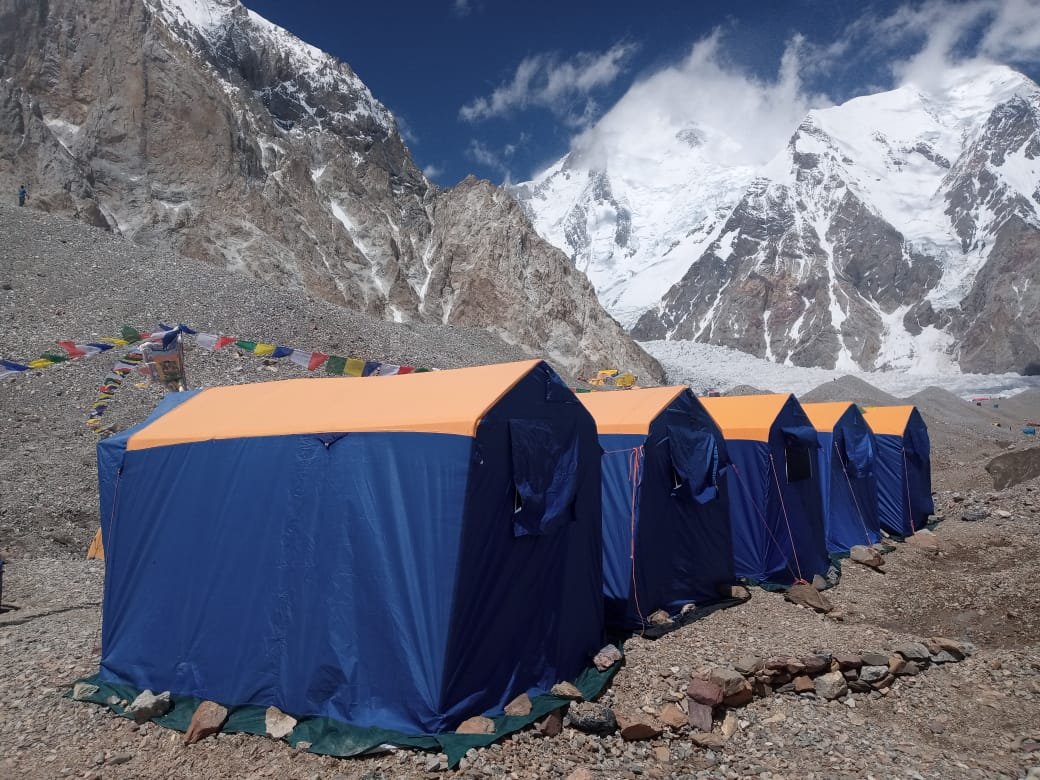
Trek ~3 hours southeast up the South Gasherbrum Glacier to the shared Gasherbrum Base Camp (5,100 m). Establish BC, set up tents, cook tent, and communications.
Day 14–18: Base Camp Acclimatization
Rest and hydration at BC. Doctor conducts baseline SpO2 and health assessments. Short glacier walks for acclimatization. Gear organization and load preparation for Camp 1
Day 19–22: Camp 1 Rotation (5,900 m)
First rotation up the Gasherbrum La approach couloir to Camp 1. Fix ropes on steeper sections. Sleep at C1 one night. Return to BC for 2-day rest.
Day 23–26: Camp 2 Rotation (6,500 m)
Second rotation. Ascend through the Hidden South Face couloirs to Camp 2 on the upper glacier shelf. Stock C2 with food and fuel. Return to BC for full rest.
Day 27–30: Camp 3 Rotation (7,050 m)
Third rotation up the steep upper face couloirs to Camp 3 below the summit pyramid. Fix ropes on the crux rocky band. Oxygen systems deployed if used. Return to BC.
Day 31–35: Weather Window Monitoring
Active weather monitoring from Base Camp using MeteoBlue satellite forecasts. Short fitness hikes on glacier moraines. Doctor conducts final fitness assessments. Summit logistics finalized.
Day 36: BC → Camp 1 (Summit Bid Day 1)
Depart Base Camp early. Ascend to Camp 1 (5,900 m). Rest, high-calorie meals, equipment checks. Weather forecast reviewed over radio with BC team.
Day 37: Camp 1 → Camp 2 (Summit Bid Day 2)
Ascend to Camp 2 (6,500 m). Continue rope-fixing if required. Energy conservation critical. Hydrate aggressively with warm liquids. Weather confirmed for C3 push.
Day 38: Camp 2 → Camp 3 (Summit Bid Day 3)
Ascend to Camp 3 (7,050 m). Pack reduced to summit kit under 8 kg. Oxygen systems tested and flow rates set. Final weather forecast confirmed. Early sleep by 6 PM.
Day 39: Summit Day (8,080 m)
Depart C3 at 1:00–2:00 AM. Navigate the upper couloirs and the crux mixed rock-ice band. Reach the summit snowfield and push to the highest point (8,080 m). Descend to C3 the same day.
Day 40–41: Descent to Base Camp
Day 40: Descend C3 → C2 → C1 → Base Camp. Full medical checks, rehydration and celebration. Day 41: complete rest day at BC.
Day 42–46: Base Camp → Askole Trek Out
Reverse approach: Concordia → Goro II → Urdukas → Paju → Jhola → Askole over 4–5 days. Porter wages finalized at Askole village.
Day 47–48: Askole → Skardu → Islamabad
Drive from Askole to Skardu. Team debrief dinner. Fly or drive to Islamabad. Permits and LO paperwork returned to PAC. Expedition concludes.

Fill up the Form

Inquiry Form

Affiliated with & Licence

Affiliated 1
Affiliated 2
Affiliated 3
Chat with us on WhatsApp
Scroll to Top