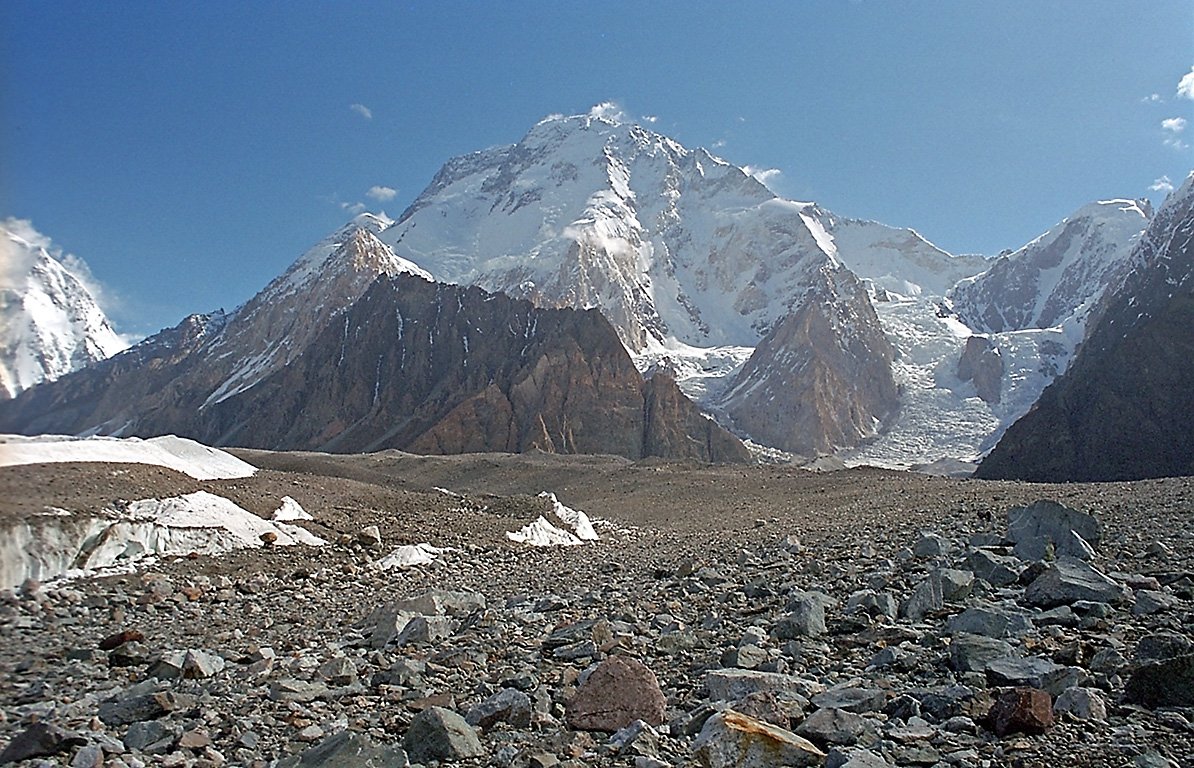
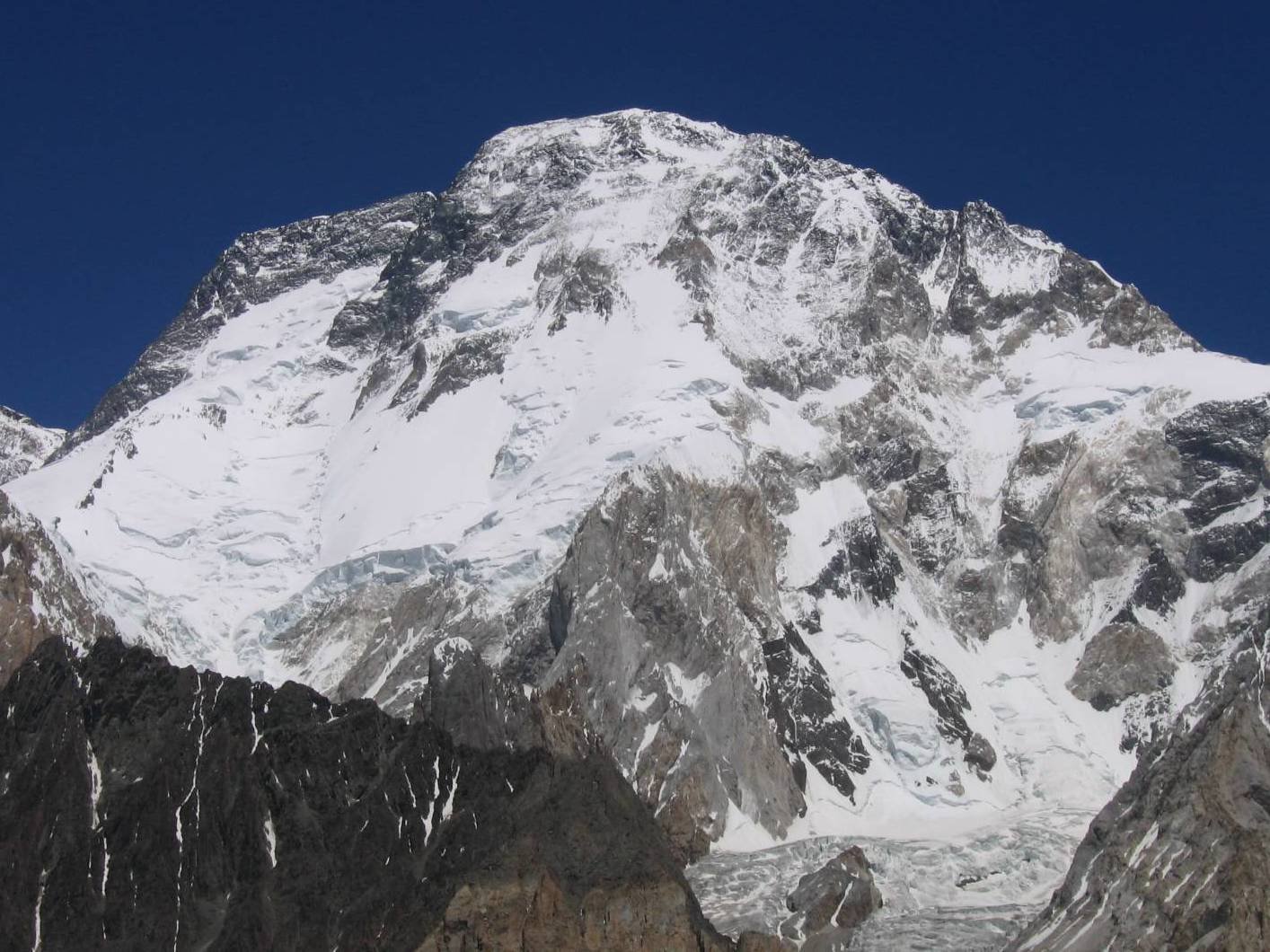
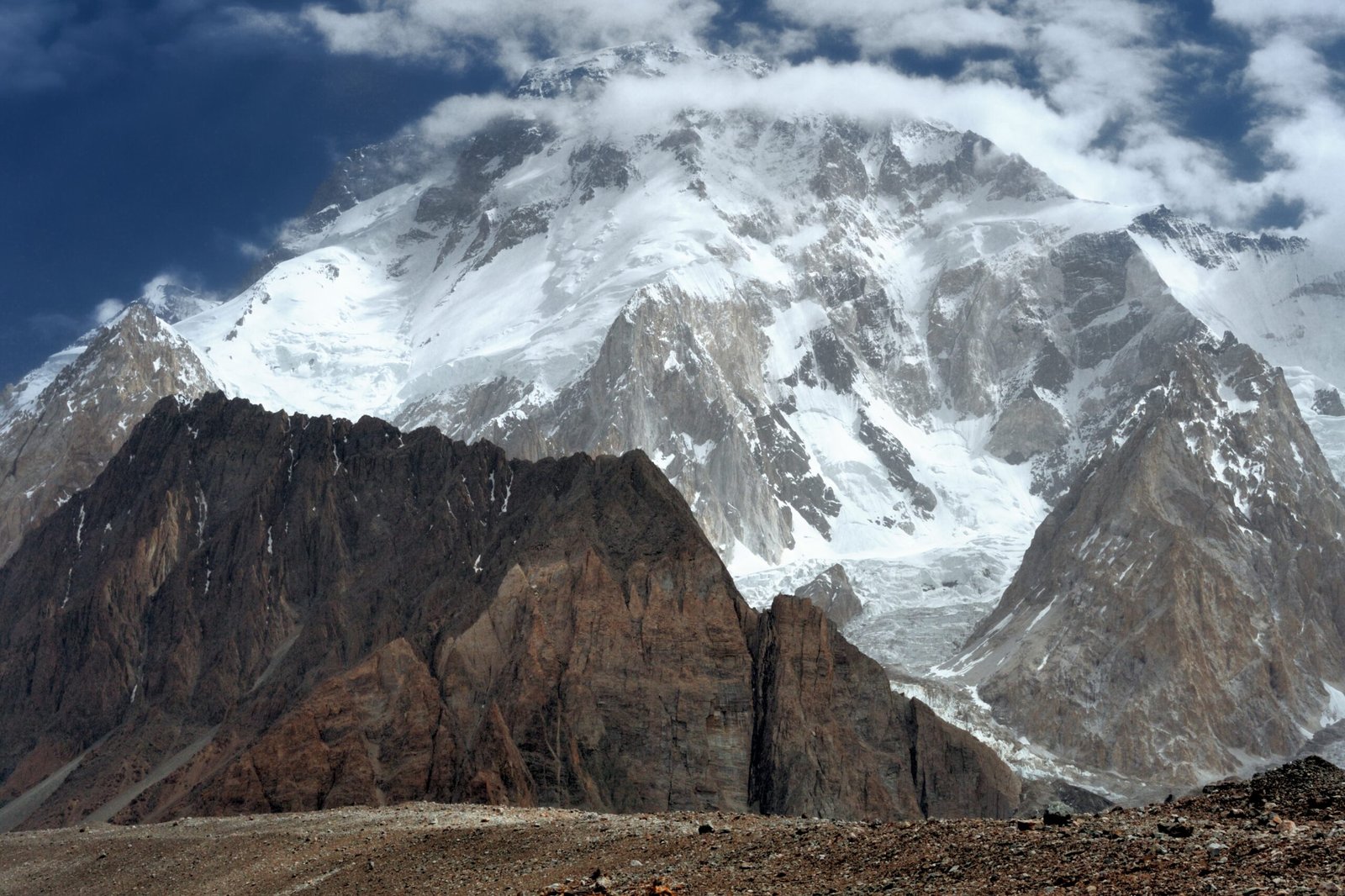
Broad Peak (8,047 m / 26,401 ft) is the twelfth-highest mountain in the world and the third-highest peak in Pakistan, located on the border of Pakistan’s Gilgit-Baltistan region and China’s Xinjiang province in the central Karakoram range. It sits just 8 kilometres northeast of K2, and the two peaks share a Base Camp area on the Godwin-Austen Glacier. The mountain takes its name from the remarkably wide summit plateau — nearly 1.5 kilometres across — that was clearly visible to early surveyors from Concordia. Its official survey designation is K3, assigned during the same Great Trigonometrical Survey that named K2.
Broad Peak is often described as one of the more accessible 8,000-metre peaks, earning it the somewhat misleading nickname the Gentle Giant. While it lacks the extreme technical difficulty of K2 or the extreme altitude of Everest, it is by no means a straightforward objective. The standard route — the West Face and Northwest Ridge — involves a long glacier approach, steep snow couloirs, and a summit day that crosses the infamous Fore Summit (8,028 m) before continuing along a corniced ridge to the true Main Summit. The vertical gain from Base Camp to the summit exceeds 3,100 metres, and the summit push from the highest camp typically takes 10–14 hours round-trip. Poor weather, avalanche risk on the upper couloirs, and the insidious challenge of spending hours in the death zone above 8,000 m make Broad Peak a serious undertaking.
The first ascent was made on 9 June 1957 by an Austrian team: Fritz Wintersteller, Marcus Schmuck, Kurt Diemberger, and Hermann Buhl — the legendary first ascentionist of Nanga Parbat. Remarkably, all four reached the summit without the use of high-altitude porters or supplemental oxygen, an extraordinary achievement for the era. Buhl died just 10 days later attempting Chogolisa nearby, adding a sombre chapter to Broad Peak’s history. Today, the mountain attracts climbers from around the world seeking their first 8,000 m summit or using it as acclimatization for a subsequent K2 attempt.
The following itinerary covers a standard expedition of approximately 48 days using the West Face / Northwest Ridge route (standard route). Weather window days are variable and may extend the expedition by up to 10 days.
Days Stage Description
Day 1–2 Islamabad Arrival Arrive in Islamabad. Team introductions, gear inspection, and permit collection from the Pakistan Alpine Club (PAC). Hotel rest.
Day 3 Islamabad → Skardu Fly to Skardu (2,438 m) — scenic Karakoram Highway drive if flight cancelled. Acclimatization walk around Kachura Lake. Rest and team briefing.
Day 4–5 Skardu Preparation Final resupply, porter hiring, and food packing. Medical check-up and altitude medication briefing. Visit Skardu Fort for a short altitude hike (~3,100 m).
Day 6 Skardu → Askole 4–5 hour jeep drive along Braldu River Valley to Askole (3,015 m), the last inhabited village. Camp setup. Porter loads finalized (max 25 kg per load).
Day 7–8 Askole → Jhola & Paju Trek begins on Day 7 to Jhola (3,110 m) through canyon terrain alongside the Braldu River. Day 8 advance to Paju (3,400 m) with views of the Trango Towers.
Day 9 Paju Rest Day Mandatory acclimatization rest at Paju per Pakistan Alpine Club regulations. Short hike up adjacent moraine ridge. Glacier gear checks.
Day 10–11 Paju → Urdukas & Goro II Trek across the Baltoro Glacier. Day 10 camp at Urdukas (4,050 m) — spectacular Cathedral Peaks panorama. Day 11 to Goro II (4,300 m).
Day 12 Goro II → Concordia Arrive at Concordia (4,600 m). First views of Broad Peak's massive west face and the entire Gasherbrum massif. Afternoon rest and photography.
Day 13 Concordia → Broad Peak BC Trek 3–4 hours northeast to Broad Peak Base Camp (4,900 m) at the foot of the West Face. Establish Base Camp, unpack expedition loads, set up cook tent.
Day 14–18 Base Camp Acclimatization Rest, hydration, and lower-glacier walks. Doctor assesses SpO2 and health baseline. Cook team established. Communication systems (SAT phone, radio) tested.
Day 19–22 Camp 1 Rotation (5,900 m) First rotation up the lower couloir and rocky rib to Camp 1 on the West Ridge. Fix ropes on key sections. Sleep one night at C1, return to BC next day.
Day 23–26 Camp 2 Rotation (6,550 m) Second rotation. Ascend through the broad couloir above C1 to Camp 2 on the upper snowfields. Stock supplies and fix further ropes. Return to BC for 2-day rest.
Day 27–30 Camp 3 Rotation (7,100 m) Third rotation up the upper West Face snowfields to Camp 3, just below the Fore Summit ridge. Oxygen system deployment (if used). Return to BC. Full rest 2–3 days.
Day 31–35 Weather Window Monitoring Active weather monitoring from Base Camp. Short glacier walks to maintain fitness. Team doctor conducts final fitness assessments. Logistics for summit bid finalized.
Equipment & Gear List
The following lists represent the minimum recommended equipment for a Broad Peak expedition. All gear should be tested in cold and wet conditions before departure. Personal pack weights at Base Camp should not exceed 22 kg.
1. Clothing & Footwear
| Item |
Qty |
Notes |
| Down Suit (7,000 m+ rated) |
1 |
Essential for summit day; 700–800 fill power minimum |
| Hard Shell Jacket & Pants |
2 sets |
Waterproof/windproof Gore-Tex outer layer |
| Softshell Jacket & Pants |
1 set |
Mid-elevation climbing and camp use |
| Mid-Layer Fleece / Down Jacket |
2 |
Insulation layer for high camps |
| Base Layers (top & bottom) |
3 sets |
Moisture-wicking merino wool or synthetic |
| Gloves: Liner / Mid / Expedition Mitts |
1 pair each |
Three-layer system for all temperatures |
| Balaclava & Neck Gaiter |
2 |
Wind protection above 7,000 m |
| Warm Hat & Sun Hat |
1 each |
Beanie for cold; wide brim for glacier approach |
| High-Altitude Boots (7,000 m rated) |
1 pair |
Double boots e.g. La Sportiva Olympus Mons or Scarpa Phantom 8000 |
| Trekking / Approach Boots |
1 pair |
For Base Camp approach trek |
| Camp Booties (insulated) |
1 pair |
Inside tent use at high camps |
| Gaiters |
1 pair |
Essential for snow on upper West Face couloirs |
| Trekking Socks (wool/synthetic) |
6 pairs |
Thick pairs for high altitude; thinner for approach |
| Sunglasses (Category 4) |
2 pairs |
Glacier UV is extreme; always carry a spare |
2. Climbing Hardware
| Item |
Qty |
Notes |
| Climbing Harness (expedition) |
1 |
Must fit over down suit; test before departure |
| Ascender / Jumar (pair) |
1 pair |
For fixed-rope progress on steep sections |
| Belay / Rappel Device (ATC or Figure-8) |
1 |
For rappel descents on West Face |
| Locking Carabiners |
8–10 |
Screw-gate and auto-locking mix |
| Non-locking Carabiners |
8–10 |
Clipping fixed lines and running protection |
| Ice Axe (technical curved pick) |
1–2 |
One technical axe; one straight walking axe for approach |
| Crampons (12-point technical) |
1 pair |
Anti-balling plates; compatible with 7,000 m boots |
| Helmet (CE/UIAA certified) |
1 |
Rockfall and ice debris risk on West Face |
| Trekking Poles (telescoping) |
1 pair |
Glacier approach and descent |
| Slings (120 cm) |
4–6 |
Dyneema or nylon for anchor building |
| Prussik Cords (6 mm, 60 cm) |
2 |
Self-rescue and crevasse extrication |
| Snow Pickets / Snow Stakes |
4–6 |
Team shared; for anchor building on upper snowfields |
3. Camp & Bivouac Equipment
| Item |
Qty/Spec |
Notes |
| 4-Season Expedition Tent |
2-person |
Wind-rated to 80+ km/h; semi-geodesic preferred |
| Sleeping Bag (-30°C rated) |
1 |
For Camp 3 and summit night; 850+ fill power down |
| Sleeping Bag (-15°C rated) |
1 |
Base Camp and lower camps |
| Insulated Sleeping Pad (R-value 5+) |
2 |
Foam + inflatable combination for redundancy |
| Expedition Backpack (70–80 L) |
1 |
Load carrying between camps |
| Summit Pack (25–30 L) |
1 |
Lightweight summit day pack under 8 kg loaded |
| Expedition Duffel Bags |
2–3 |
Porter loads; max 25 kg each |
| High-Altitude Stove (e.g. MSR Reactor) |
2 |
Spare burner essential; test in cold before trip |
| Fuel Canisters |
20–25 |
~2–3 canisters per camp per rotation |
| Insulated Cooking Pot & Mug |
1 set |
Insulated mug critical above 6,000 m |
| Headlamp + Spare Batteries (lithium) |
2 headlamps |
Summit departure is pre-dawn; lithium only at altitude |
| Water Bottles (insulated, 1 L) |
2 |
Wide-mouth; prevent freezing above 7,000 m |
| Water Filter / Purification Tablets |
1 |
For lower camps and approach; boil at high camps |
| Nutrition: High-calorie Snacks |
Ample supply |
Nuts, gels, bars, instant noodles, freeze-dried meals for all camps |
4. Oxygen & Medical Equipment
| Item |
Qty |
Notes |
| Supplemental Oxygen Cylinders (4L) |
2–4 per climber |
Optional but recommended above 7,500 m; mandatory for safety emergencies |
| Oxygen Regulator + Mask |
1 set (+ spare) |
If oxygen carried; ensure regulator is altitude-rated |
| Gamow Bag (team) |
1 at BC |
Portable hyperbaric chamber for HACE/HAPE emergencies |
| Pulse Oximeter |
3 (team) |
Monitor SpO2 at all camps; critical safety tool |
| Dexamethasone 8 mg injectable |
Per protocol |
HACE emergency treatment |
| Nifedipine 30 mg extended-release |
Per protocol |
HAPE emergency treatment |
| Diamox (Acetazolamide) |
Per protocol |
Acclimatization support and AMS prevention |
| SAT Phone + GPS/EPIRB Beacon |
1 each |
Emergency communication and location |
Additional Medical Kit (per expedition)
- Ibuprofen 400 mg, paracetamol, co-codamol — pain management
- Loperamide (Imodium) and oral rehydration salts — GI issues at altitude
- Blister kit: moleskin, compeed, wound closure strips, antiseptic
- Snowblindness drops: tetracaine for pain relief, antibiotic drops
- Frostbite kit: ibuprofen 400 mg, aloe vera gel, non-adherent dressings
- Throat lozenges and steam inhaler — dry altitude cough is universal
- Sunscreen SPF 50+ and lip balm — glacier UV causes severe burns
Broad Peak (8,047 m) is frequently recommended as a stepping stone to higher 8,000 m peaks such as K2 because it is technically less demanding than its neighbours. The standard West Face / Northwest Ridge route involves long but relatively moderate snow and ice slopes without the extreme mixed rock sections found on K2's Abruzzi Spur. Its Base Camp is also shared with K2 expeditions, and the mountain has a comparatively higher summit success rate of around 35–40%. Nevertheless, it is still a serious Himalayan objective that demands full 8,000 m expedition preparation.
The summer pre-monsoon season — late June through early August — is the only viable window. July is typically the most stable month, offering the best combination of settled weather and reasonable temperatures. Storm cycles can move in rapidly from the southwest, so teams must be ready to exploit short windows of 2–4 days. Winter ascents of Broad Peak have been made but are rare and far more hazardous.
A Royalty Permit from Pakistan's Ministry of Tourism and the Pakistan Alpine Club (PAC) is mandatory. The current permit fee for Broad Peak is approximately USD 1,150 per climber. Teams must also pay a government-appointed Liaison Officer (LO) salary and expenses, an environmental deposit (refundable), and porter insurance. All paperwork should be completed at least 3 months before the expedition start date.
The approach trek from Askole to Broad Peak Base Camp (4,900 m) takes approximately 6–7 days following the Baltoro Glacier. It passes through some of the most dramatic mountain scenery on Earth, including the Cathedral Spires, Trango Towers, and the Gasherbrum massif visible from Concordia. Porters carry loads up to 25 kg and are paid daily wages set by the Gilgit-Baltistan Tourism Department.
Broad Peak is most commonly climbed without supplemental oxygen, and many guided teams complete the ascent without it. However, oxygen is strongly recommended for climbers with limited 7,000 m experience, and all teams should carry oxygen for emergency use regardless of summit strategy. The summit push from Camp 3 (7,100 m) to the main summit (8,047 m) spends significant time in the death zone and can take 8–12 hours round-trip.
The Fore Summit (approximately 8,028 m) is a separate high point on Broad Peak's summit ridge situated roughly 500 metres of horizontal distance from the true Main Summit (8,047 m). Many climbers, particularly in poor weather or late in the day, have stopped at the Fore Summit believing they have reached the top. The true summit requires continuing along a sometimes-corniced ridge with additional elevation. Reaching the Main Summit is necessary for a valid ascent of Broad Peak in all recognised records.
A full Broad Peak expedition typically runs 48–55 days from Islamabad arrival to return. This includes the 6-day approach, 4–6 weeks on the mountain for acclimatization and summit bids, and the 5-day trek out. Fully supported guided expeditions range from USD 15,000 to USD 35,000 per person depending on the operator and services. Independent expeditions can be organized for USD 8,000–15,000 but require considerable self-sufficiency and prior 8,000 m experience.
Broad Peak is appropriate for climbers with prior high-altitude experience at 6,000–7,000 m, ideally including at least one summit above 7,000 m. Technical skills required include proficiency on steep snow and ice (up to 50–55°), crevasse travel, self-arrest, jumar ascent on fixed ropes, and basic anchor building. Guided operators typically require a minimum of two 6,000 m or higher peaks as prerequisites. An excellent physical fitness base is essential.
Rapid weather deterioration is the primary risk. Storms fuelled by the southwest monsoon can move in within hours, bringing heavy snowfall and whiteout conditions. Wind slab avalanche risk increases significantly after snowfall on the upper West Face couloirs. Wind speeds above 7,000 m can exceed 80 km/h during storm events. Teams monitor weather via satellite forecasts (e.g. MeteoBlue high-altitude forecasts) and rely on Base Camp radio contact for real-time updates.
Each expedition team includes or contracts a Base Camp doctor responsible for daily health monitoring, SpO2 readings, and emergency intervention. AMS, HACE, and HAPE are treated by immediate descent — this is the definitive treatment. The team Gamow bag provides emergency hyperbaric therapy until descent is possible. Helicopter evacuation is available to Base Camp level (~4,900 m) in good conditions but cannot be relied upon. Above Base Camp, sick climbers must be assisted down by teammates.
Arrive in Islamabad. Team introductions, gear inspection, and permit collection from the Pakistan Alpine Club (PAC). Hotel rest.
Fly to Skardu (2,438 m) — scenic Karakoram Highway drive if flight cancelled. Acclimatization walk around Kachura Lake. Rest and team briefing.
Final resupply, porter hiring, and food packing. Medical check-up and altitude medication briefing. Visit Skardu Fort for a short altitude hike (~3,100 m).
4–5 hour jeep drive along Braldu River Valley to Askole (3,015 m), the last inhabited village. Camp setup. Porter loads finalized (max 25 kg per load).
Trek begins on Day 7 to Jhola (3,110 m) through canyon terrain alongside the Braldu River. Day 8 advance to Paju (3,400 m) with views of the Trango Towers.
Mandatory acclimatization rest at Paju per Pakistan Alpine Club regulations. Short hike up adjacent moraine ridge. Glacier gear checks.
Trek across the Baltoro Glacier. Day 10 camp at Urdukas (4,050 m) — spectacular Cathedral Peaks panorama. Day 11 to Goro II (4,300 m).
Arrive at Concordia (4,600 m). First views of Broad Peak's massive west face and the entire Gasherbrum massif. Afternoon rest and photography.
Trek 3–4 hours northeast to Broad Peak Base Camp (4,900 m) at the foot of the West Face. Establish Base Camp, unpack expedition loads, set up cook tent.
Rest, hydration, and lower-glacier walks. Doctor assesses SpO2 and health baseline. Cook team established. Communication systems (SAT phone, radio) tested.
First rotation up the lower couloir and rocky rib to Camp 1 on the West Ridge. Fix ropes on key sections. Sleep one night at C1, return to BC next day.
Second rotation. Ascend through the broad couloir above C1 to Camp 2 on the upper snowfields. Stock supplies and fix further ropes. Return to BC for 2-day rest.
Third rotation up the upper West Face snowfields to Camp 3, just below the Fore Summit ridge. Oxygen system deployment (if used). Return to BC. Full rest 2–3 days.
Active weather monitoring from Base Camp. Short glacier walks to maintain fitness. Team doctor conducts final fitness assessments. Logistics for summit bid finalized.
Depart Base Camp. Ascend to Camp 1 (5,900 m). Rest, eat high-calorie meals, check equipment. Weather forecast reviewed for C1 to C3 push.
Ascend to Camp 2 (6,550 m). Continue rope-fixing if required. Conserve energy; limit time outside tent. Hydrate aggressively. Rest for C3 push.
Ascend to Camp 3 (7,100 m). Prepare summit kit: reduce pack to <10 kg. Final weather forecast check via BC radio. Oxygen systems checked if used. Early sleep (6 PM).
Depart C3 at 1:00–2:00 AM. Ascend the Fore Summit slopes (~7,550 m), traverse the summit ridge, and push to the Main Summit (8,047 m). Return to C3 same day. Critical: descend before dark.
Descend from C3 through C2 and C1 to Base Camp on Day 40. Full medical checks, rehydration, and celebration. Day 41 full rest day at BC
Reverse the approach trek: Concordia → Goro II → Urdukas → Paju → Jhola → Askole over 4–5 days. Porter wages finalized at Askole.
Drive from Askole to Skardu. Debrief dinner. Fly or drive to Islamabad. Permits returned to PAC. Expedition concludes.